The Euphorb Mini-Fairy Bee (Perdita minima) is a solitary bee of the deserts of the south-western United States and northern Mexico. It is under 2 mm long,[1] and a 2024 checklist calls it the smallest bee species in the Americas.[2] It nests in sandy soil and collects pollen from spurges.[1][3]
Quick facts
Description
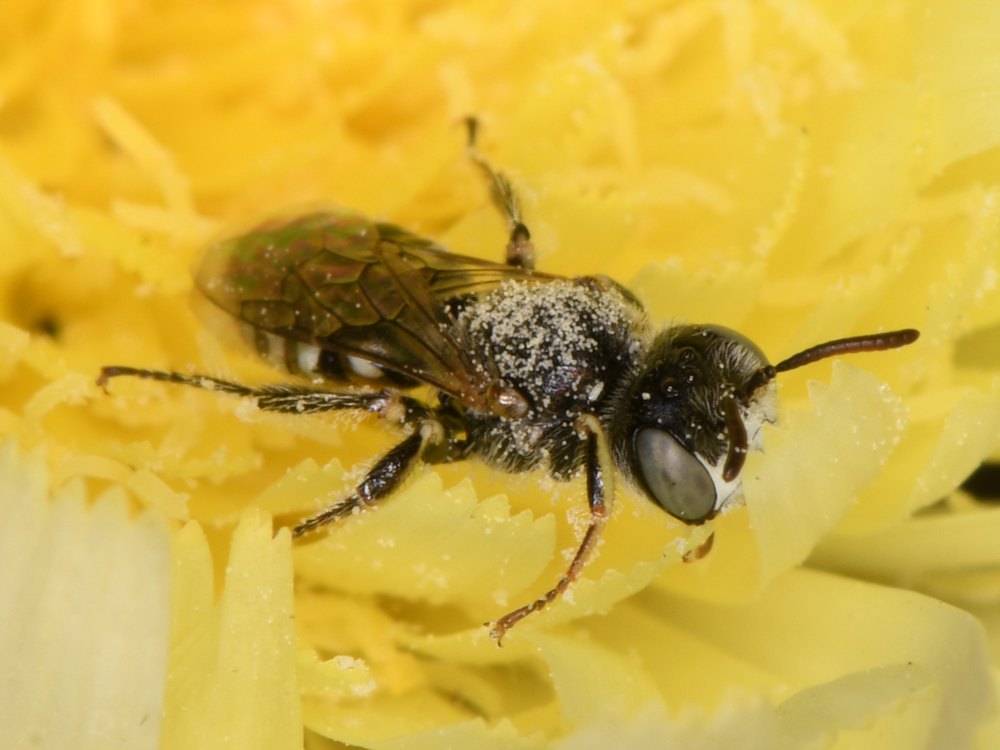
Perdita minima is described as yellow to tan and almost translucent.[4] It carries the pollen it collects on its hairy hind legs.[1]
Bees of the genus Perdita in general are small, and many have white or yellow marks on the face, body or legs.[4]

Name
Theodore D. A. Cockerell named Perdita minima in 1923.[5][6][7] The first specimen, the holotype, is a female collected at Tempe, Arizona, on 30 July 1917 and kept in the American Museum of Natural History.[2] iNaturalist lists the English name “Euphorb Mini-Fairy Bee” for it; a euphorb is a spurge, the plant it collects pollen from.[8] Minima comes from the Latin minimus, “smallest”.[9]
Body
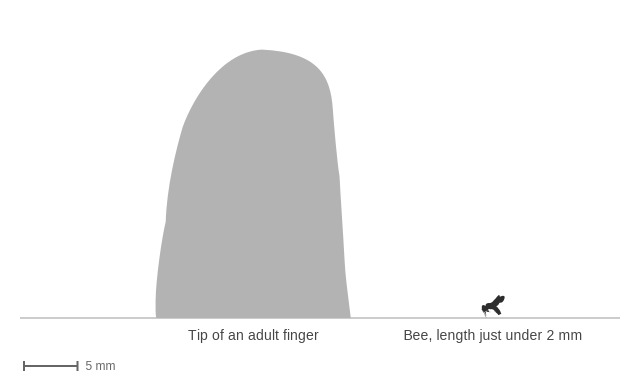
The USDA Forest Service gives the length as slightly less than 2 mm,[1] Guinness World Records as just under 2 mm[10] and a popular article as about 1.8 mm.[4] Guinness gives the weight as 0.333 mg.[10] In the 2024 checklist of the bees of the Baja California Peninsula it is called the smallest bee species in the Americas.[2]
Size ranges
| Weight | about 0.33 mg |
| Length | just under 2 mm |
Behavior
It is a solitary bee that digs a small nest in sandy desert soil.[1] It moves quickly from flower to flower in a nervous, quivering way and stays only a moment on each blossom.[4] Of the 632 records in GBIF that have a month, 582 are from July to September, and the others range from April to October.[5] USDA says the bees fly in summer and fall, timed to the flowering of their food plants.[1]
Diet
The bee feeds on the nectar and pollen of spurge-family wildflowers, and it often visits small whitemargin sandmat (Chamaesyce albomarginata, also written Euphorbia albomarginata). The tiny white flowers give adults and larvae the nectar and pollen they need.[1] It is a pollen specialist: the 2024 Baja California checklist and Fowler’s list of pollen-specialist bees both give Euphorbia as the plant it collects pollen from.[2][3]
Habitat and range
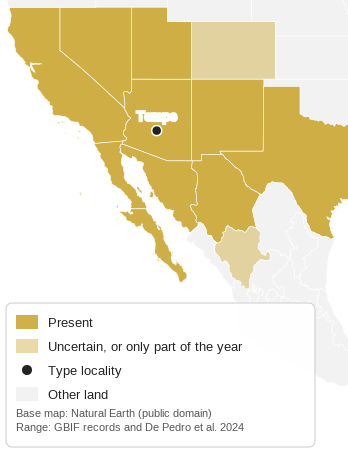
It lives in the south-western United States and northern Mexico.[2] GBIF holds 1,070 records, 827 from the United States and 237 from Mexico. The most are from Arizona (388), California (254), Sonora (190) and Nevada (119), followed by New Mexico (50), Chihuahua (42) and Texas (11).[5] The Baja California checklist reports it from coastal scrub of succulent plants, the Magdalena Plains and the Gulf coast of the peninsula.[2] Many records come from desert places such as Anza-Borrego Desert State Park in California, Sabino Canyon in Arizona and Big Bend National Park in Texas.[5]
Evolution
The dates describe the bee family and the genus, not Perdita minima itself. A dated family tree places the origin of the mining bees (family Andrenidae) at about 90 million years ago, in the late Cretaceous. Panurginae, the subfamily that contains Perdita, has living members that share an ancestor about 67 million years old, in the same study.[11] The genus has about 640 species, and the rate at which new species formed rose steeply over the last 15 million years.[11] Perdita lives only in North America, mostly in the dry south-west, and most of its species depend on a few host plants and fly in a short season.[11]
Forms and variants
GBIF, the Catalogue of Life and ITIS list no subspecies, synonyms or colour forms of Perdita minima.[5][6][7]
Conservation
The species is Not evaluated: GBIF shows no IUCN Red List category for it.[5]
History and culture
Cockerell described the species in 1923 from the Tempe specimen (see Name).[2] Guinness World Records lists it as the smallest species of bee, just under 2 mm long and 0.333 mg in weight.[10] The Australian Native Bee Research Centre names an Australian bee, Euryglossina (Quasihesma) clypearis, that claims the same title, and says it is hard to tell which is smaller.[12] The USDA Forest Service has featured Perdita minima as a Pollinator of the Month.[1]
Taxonomy
| Rank | Name |
|---|---|
| Kingdom | Animalia |
| Phylum | Arthropoda |
| Subphylum | Hexapoda |
| Class | Insecta |
| Subclass | Pterygota[14] |
| Infraclass | Neoptera[14] |
| Superorder | Holometabola[14] |
| Order | Hymenoptera |
| Suborder | Apocrita[14] |
| Infraorder | Aculeata[14] |
| Superfamily | Apoidea[14] |
| Family | Andrenidae (mining bees)[6] |
| Subfamily | Panurginae[14] |
| Tribe | Panurgini[14] |
| Genus | Perdita |
| Species | Perdita minima (Cockerell, 1923)[5][6][7] |
Higher classification
Perdita minima is a mining bee (family Andrenidae) in the order Hymenoptera, the insects that also include wasps and ants.[5][7] ITIS puts the genus in the subfamily Panurginae, tribe Panurgini.[7] The genus Perdita is arranged in 17 subgenera.[13] Its close relatives are Macrotera and Pseudomacrotera, which Bossert and colleagues place with Perdita in one tribe.[11]
Subgenus and tribe
Sources disagree on two small points. The 2024 checklist of the bees of Baja California places the species in the subgenus Perditella, while GBIF, the Catalogue of Life and ITIS list no subgenus.[2][5][6][7] The Catalogue of Life also uses the tribe name Panurgini for the group of genera that Bossert and colleagues call Perditini.[6][11] Both names cover the same genera, so the bee itself is not in question.
Sources
- USDA Forest Service, Celebrating Wildflowers, “Perdita minima, World’s Smallest Bee” (Pollinator of the Month, text by Steve Buchmann)
- De Pedro et al. 2024, annotated checklist of the native bees of the Baja California Peninsula, Zootaxa 5522(1): 1–391 (treatment of Perdita (Perditella) minima)
- Fowler 2020, “Pollen Specialist Bees of the Western United States” (compiled from the literature)
- Burlew, R., “What’s Bugging: Perdita minima, the smallest of the small”, Honey Bee Suite (popular article)
- GBIF Secretariat, Perdita minima Cockerell, 1923, GBIF Backbone Taxonomy (species 1356055) and occurrence records (queried 13 November 2026)
- Catalogue of Life, Perdita minima Cockerell, 1923 (accepted name; ChecklistBank, dataset 3LR)
- ITIS, Perdita minima Cockerell, 1923 (TSN 716205)
- iNaturalist, Perdita minima (taxon page, English common name)
- Wiktionary, minimus
- Guinness World Records, “Smallest species of bee” (record page)
- Bossert et al. 2022, “Phylogeny, biogeography and diversification of the mining bee family Andrenidae”, Systematic Entomology 47: 283–302
- Australian Native Bee Research Centre (Aussie Bee), Quasihesma page
- Portman and Griswold 2017, review of Perdita subgenus Procockerellia, ZooKeys 712: 87–111
- ITIS, Perdita minima, classification