The Stalked Sea Squirt (Styela clava) is a sea squirt, an animal that lives fixed to docks and rocks and filters food out of the water. It is native to the north-west Pacific, from the Sea of Okhotsk through Japan and Korea to China.[1][2] It has spread, probably on ships and boats, to the coasts of Europe, North America, Australia and New Zealand.[1][2] Adults are usually 90 to 160 mm long.[1] Herdman named it in 1881.[3]
Quick facts
Description
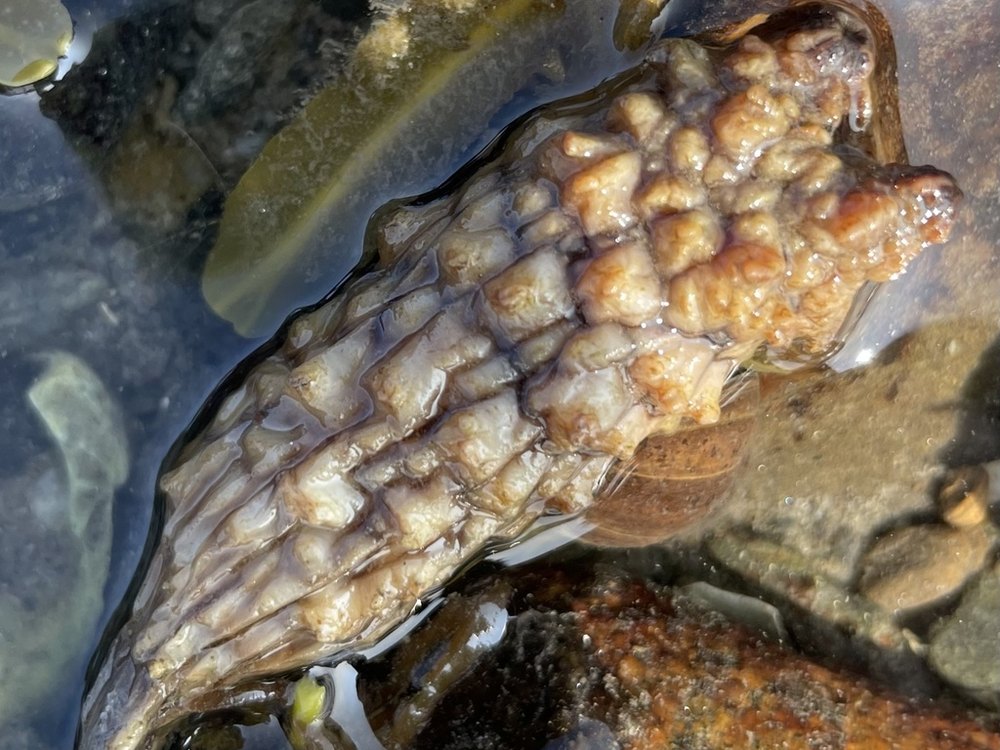
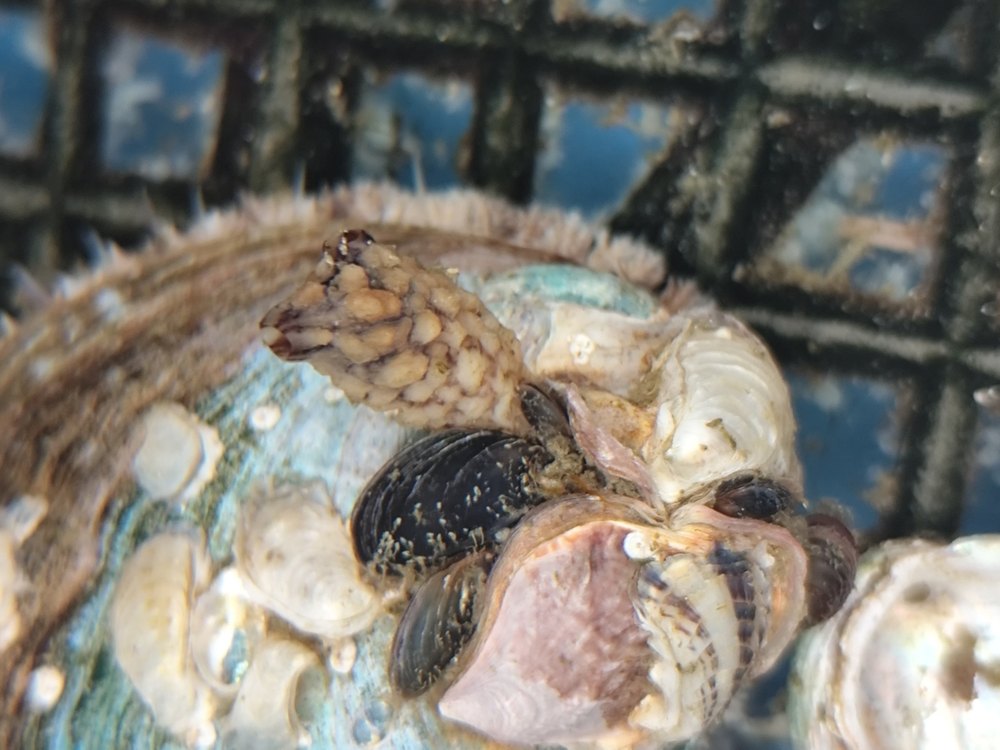
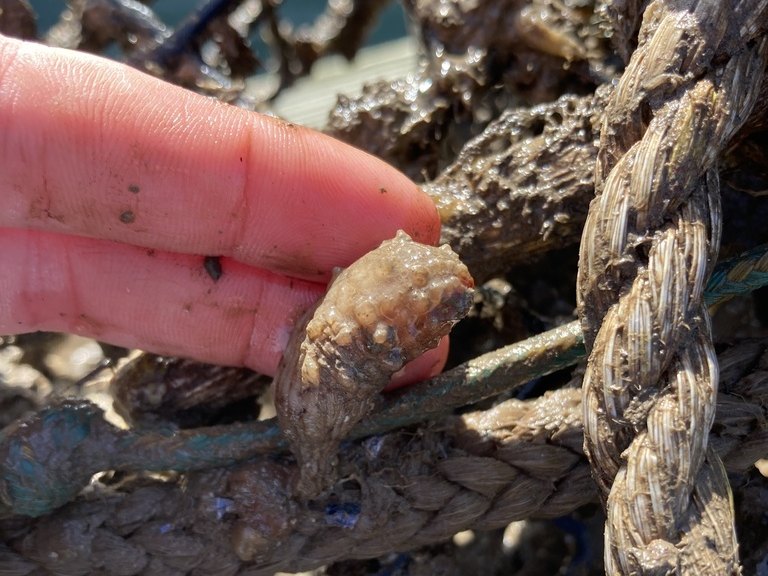
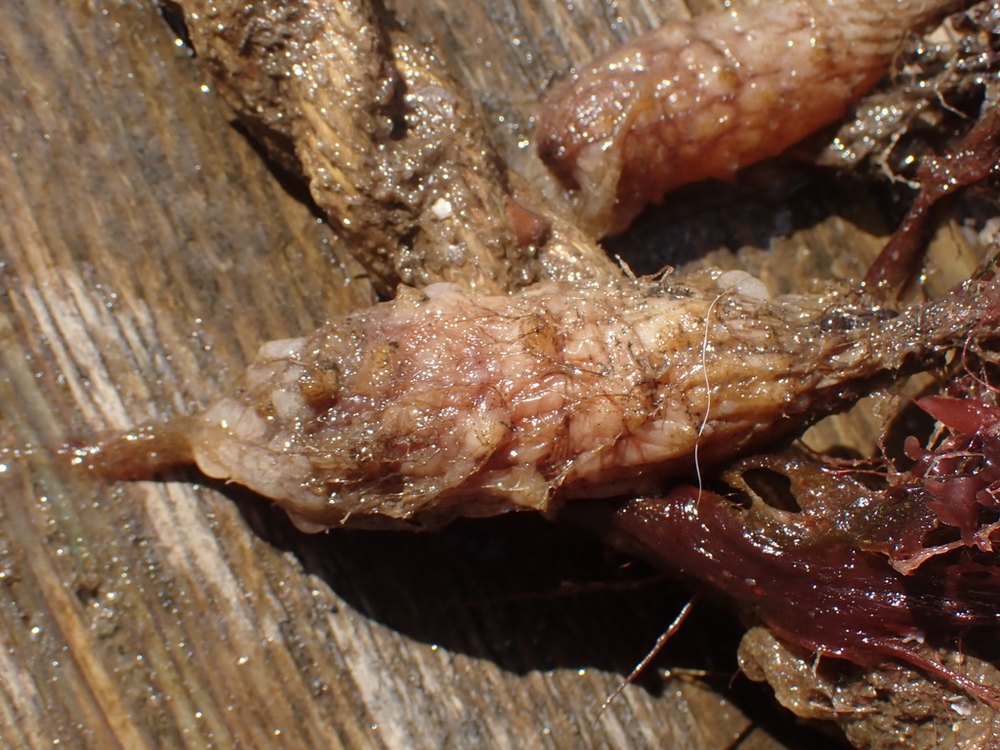
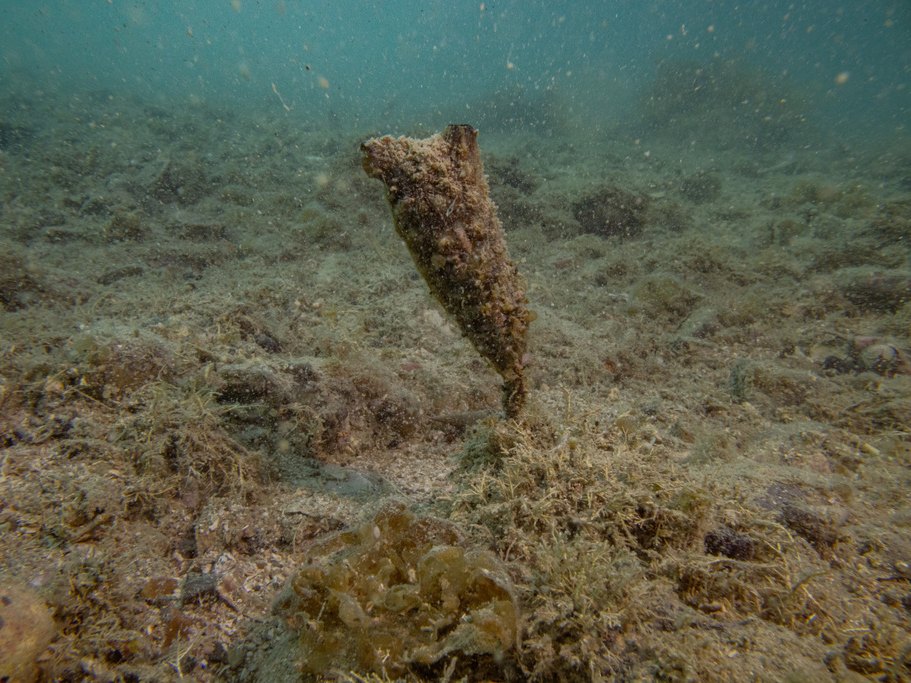
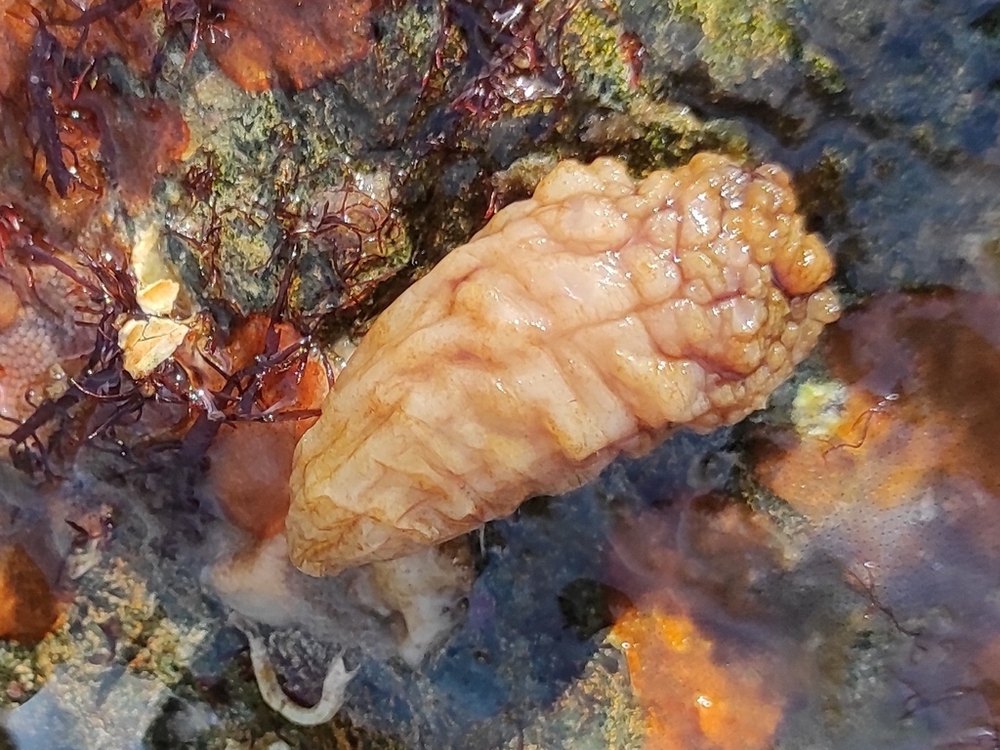
The Stalked Sea Squirt is shaped like a club or a narrow sac. The wide body tapers into a short stalk that ends in a flat, disc-like base, and the animal is fixed to hard surfaces by that base.[1][5]
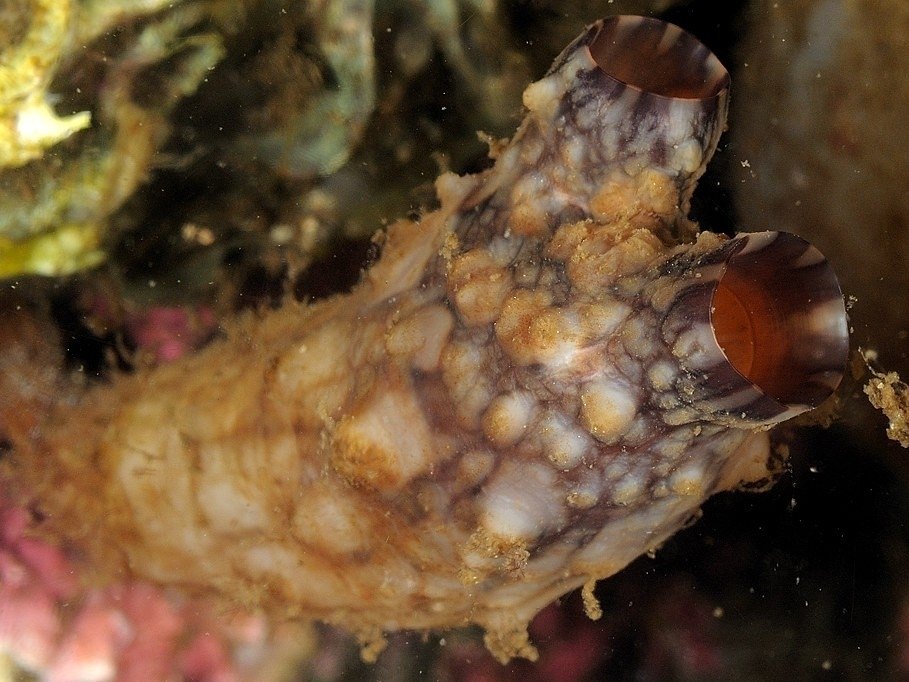
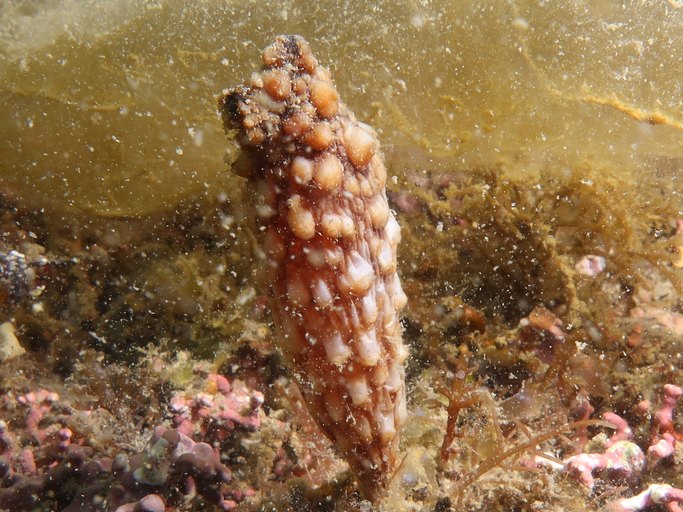
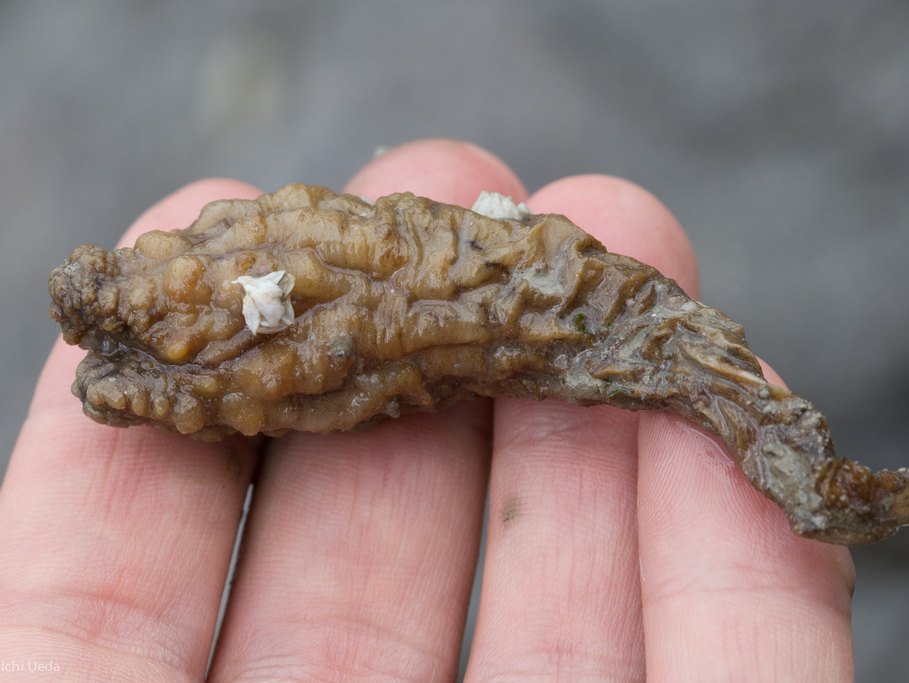
The outer coat, called the tunic, is tough and leathery. It is folded in irregular lengthwise ridges and wrinkled across, mostly near the top, and it carries large rounded bumps.[1] The colour is brown in the Canadian federal review, yellow-brown in animals from Portsmouth and orange-brown in animals from the Bassin de Thau in France.[1][5]
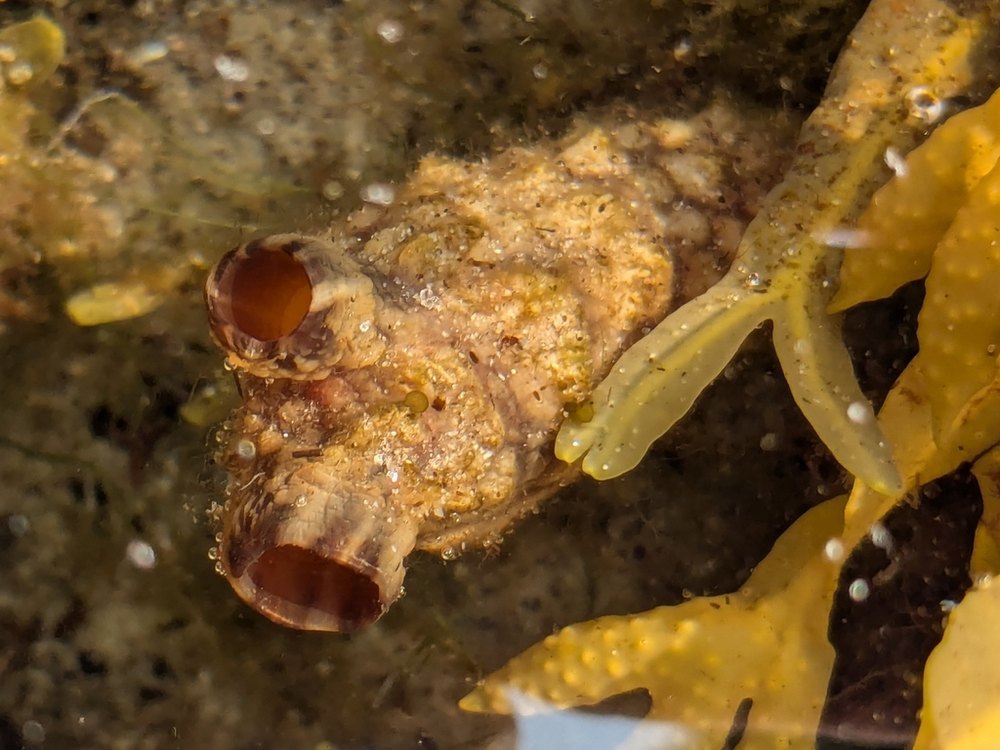
At the top are two short siphons, the two openings that take water in and let it out. They sit close together and point forward. Their edges carry four brown or purple stripes that alternate with paler bands.[1][5]
Young animals are yellowish-brown and have no stalk. They are attached directly to the surface.[1]
Name
The species word clava is Latin for “club”, and the English names Club Tunicate and Clubbed Tunicate translate it.[3][6] A tunicate is a sea squirt or a close relative of one, with a soft body wrapped in a tough coat called the tunic. iNaturalist calls it the Stalked Sea Squirt.[7] The checklists also list the Asian tunicate, leathery sea squirt, rough sea squirt, folded sea squirt, club sea squirt and Asian stalked tunicate.[3][8]
In other languages
| Language | Name | Meaning |
|---|---|---|
| Japanese local | エボヤ (Eboya) | — |
| Korean local | 미더덕 (mideodeok) | — |
| French | Ascidie plissée; Ascidie japonaise | — |
| Dutch | Knotszakpijp; Japanse zakpijp | — |
| German | Falten-Ascidie; Ostasiatische Seescheide | — |
| Danish | Østasiatisk søpung | — |
| Norwegian | Lærsekkdyr | — |
| Swedish | Lädersjöpung | — |
The Japanese and Korean names come from the Catalogue of Life and WoRMS common-name lists.[3][6][8] The Korean name is also the food name used in Korean papers.[4] The French and Dutch names come from the French and Dutch national species lists, and the Danish and Swedish names from the Danish and Swedish national checklists, as listed by GBIF; the German and Norwegian names come from the Catalogue of Life.[3][6][8]
Body
Size
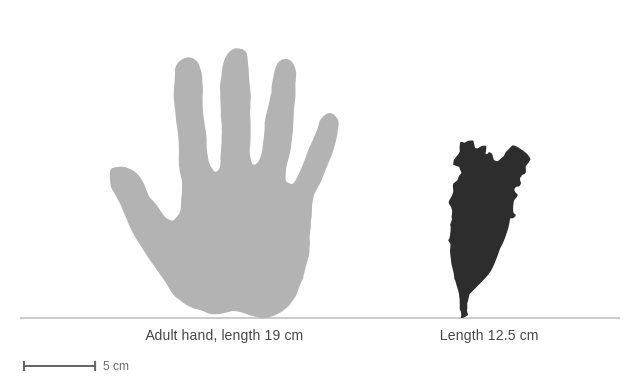
Adults are usually 90 to 160 mm long, including the stalk, according to a Canadian federal review of the species (Clarke Murray and Therriault, 2007). The same review says that in Europe the maximum is 125 mm, with 160 mm recorded in extreme cases.[1] Other sources give more. Davis and Davis, two authors who studied the species in southern France, state that adults may grow to 220 mm.[5][9] The Canadian Fisheries and Oceans species profile says up to 18 cm, with the stalk making up one third of the length.[10]
Wild animals have been measured in a few places. In the Bassin de Thau, a lagoon in southern France, specimens collected in June 2005 were 65 to 145 mm long.[5]
Weight has been measured in one wild sample. In Galicia, Spain, 14 animals collected in spring weighed 224 g together, about 16 g each. After the fouling growing on them was removed they weighed 183.7 g, about 13 g each.[11] This is one sample, not an average for the species.
| Weight (wild) | about 16 g |
| Length (wild) | 90–160 mm |
Tunic and siphons
The tunic is the largest part of the animal. In the Galicia sample it made up about 65 percent of the wet weight (118.9 g of 183.7 g), and the internal organs the rest. The tunic is about 80 percent water and the organs about 84 percent water. Cellulose is the main sugar-based material in the tunic.[11] The siphons can be closed for long periods.[1]
In a laboratory test at 12 to 28 °C and salinities of 20 to 36 g per litre, oxygen use ranged from 0.045 to 1.11 mg per hour per gram of body weight. It rose with temperature and salinity and grew with body mass.[12]
Behavior
An adult Stalked Sea Squirt does not move. It is fixed to a hard surface by the base of its stalk.[1][5]
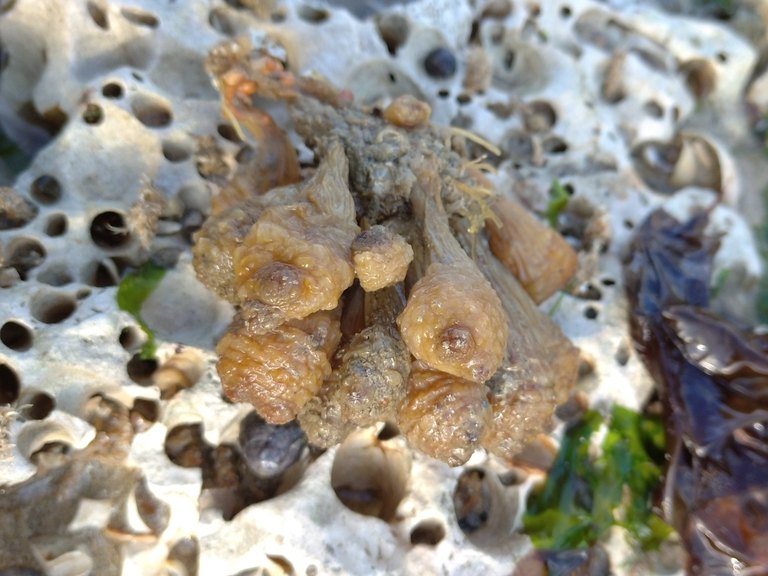
Young animals often settle on larger ones and form clusters, and most larvae settle during slack water.[1][13]
Diet
The Stalked Sea Squirt is a filter feeder. It pulls water in through the intake siphon, strains out particles in a net-like basket in its throat, and pushes the cleaned water out through the outflow siphon.[1] A Canadian federal review lists the food as microscopic algae, tiny animals and other suspended organic matter.[1]
The sources disagree on how selective it is. A laboratory study of feeding selectivity found that particle retention rose with particle size at lower food concentrations and was best for particles of 5 to 20 micrometres. At the highest food concentration, small particles were kept better and large ones worse.[14] A study of animals farmed in Jindong Bay, Korea, instead describes non-selective feeding regardless of particle size.[15]
That Korean study measured carbon and nitrogen isotopes in the farmed animals. It found they relied mostly on fine particles of 0.7 to 20 micrometres rather than coarser ones.[15]
A study at a scallop farm in Sanggou Bay, China, found about 22 animals per square metre in September, each producing 121.2 mg of dry waste a day.[16]
The Canadian federal review also quotes an older tank study in which the species removed 96 percent of the oyster larvae from the water.[1]
Life cycle
| Stage | Age / time | Notes |
|---|---|---|
| Egg | About 10 to 12 hours to hatch | Eggs and sperm are shed into the open water, and the eggs are fertilised there[1][9] |
| Tadpole larva | About 0.85 mm long; swims for about 12 to 48 hours | The larva does not feed; it lives on its own yolk[1][5][13] |
| Juvenile | Grows about 10 to 15 mm a month (California) | Small animals have no stalk and are yellow-brown[1] |
| Adult | Usually 90 to 160 mm; mature at 85 to 90 mm | Reached in 5 to 6 months in California and 10 months in Denmark[1] |
Each Stalked Sea Squirt has both eggs and sperm, so it is a hermaphrodite. It cannot fertilise its own eggs, because the male and female parts ripen at different times.[1] Spawning happens in warm water. In California it runs from early spring to autumn. In Ireland it is mostly in September and October.[1] The animals do not spawn below 15 °C.[1]
Larva and settlement
The eggs hatch about 12 hours after fertilisation, according to authors who studied the species in southern France.[5][9] A laboratory study of the species gives about 10 hours from fertilised egg to a swimming larva.[17] The larva is called a tadpole because it has a tail. It is about 0.85 mm long.[5]
Reports of how long the larva swims differ. The authors in France give about 12 hours.[5][9] The Canadian federal review gives 24 to 28 hours at 20 °C.[1] A European review gives 24 to 48 hours.[13] The larva then sticks to a hard surface by its front end. Its tail shrinks away in 20 to 30 minutes in the laboratory, and the animal becomes fixed in one place for the rest of its life.[17]
Growth and lifespan
Young animals in California grow about 10 to 15 mm a month on average.[1] They are mature at 85 to 90 mm, which took 5 to 6 months in California and 10 months in Denmark.[1] A study in Lyttelton, New Zealand, found animals mature at about 50 mm within 5 months.[18]
Sources do not agree on how long the animal lives. A Canadian federal review gives a maximum of three years,.[1] A study in Lyttelton, New Zealand, found that fewer than 5 percent of the animals survived 12 months, so the population was essentially annual. Most died in summer after spawning.[18]
Ecology
Competitors and predators
No predators of adult Stalked Sea Squirts have been recorded in north-western Europe, and the tough, leathery tunic is thought to protect them.[1] The swimming young (larvae) are eaten by animals that feed on plankton.[1] Newly settled juveniles are more at risk. In New England, almost all of them died after being eaten by the snail Mitrella lunata and by the fish called cunner, and this seemed to keep the sea squirt from establishing in some places, although adults moved there survived.[1]
A Canadian federal review calls the species a highly aggressive competitor for space and food.[1] It also filters young animals of other species out of the water, which lowers how many settle nearby. Only barnacles and spirorbid worms (small worms with coiled white tubes) were not reduced.[1] In southern California it replaced the sea squirts Pyura haustor and Ascidia ceratodes as the main sea squirt of shallow, sheltered places.[1][19] In southern England its rise matched a fall in another sea squirt, Ciona intestinalis.[1] The review says it grows faster than mussels and oysters, which have to build a shell.[1] A large settlement of young mussels in marinas of the Limfjord, Denmark, can keep it from returning.[1]
Older animals are covered by other life: corals, algae, hydroids, sponges and smaller Stalked Sea Squirts. The folds of the tunic help this fouling grow.[1] The species settles best on surfaces already fouled by other species.[1] Dense groups give other non-native species a place to live.[13]
Impacts on shellfish farms
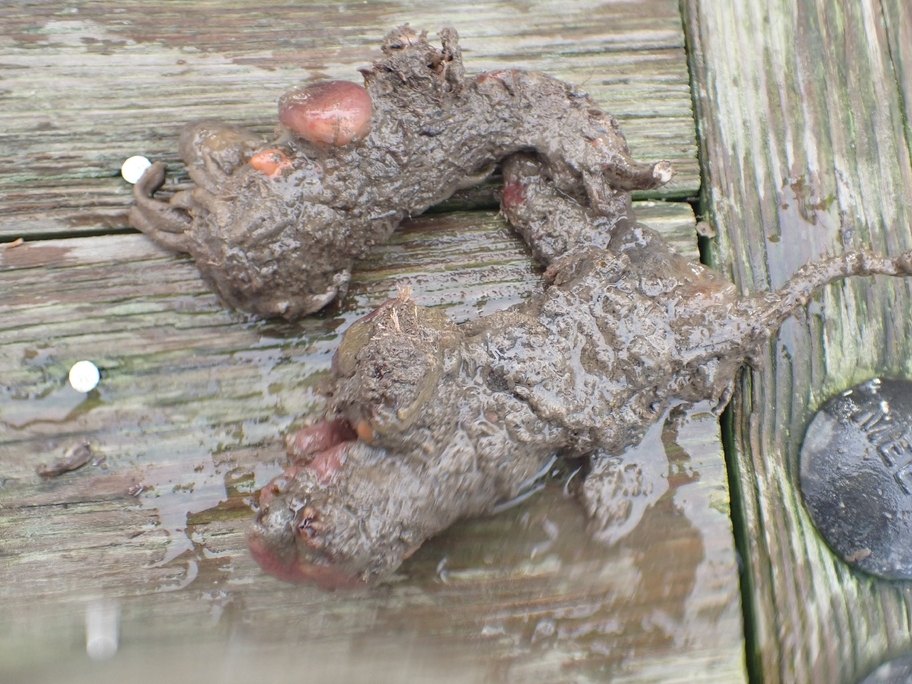
On Prince Edward Island (PEI), Canada, the Canadian federal review calls the density of the species a serious threat to the long-term economic health of the shellfish industry.[1] A federal science paper says the PEI mussel industry has been affected by invasive species since 1998. The island’s blue mussel harvest was close to 23,000 tonnes in 2013.[20] Heavy growth weighs down mussel lines and floating docks.[1][10]
Two sources give a loss figure for Canadian mussel farms, and they differ. NEMESIS says harvests are cut by about 50 percent. The Swedish Agency for Marine and Water Management says production falls by up to 40 percent in invaded farms in eastern Canada.[19][21]
In Denmark it fouls fishing gear used for cod, flounder and eel, and in Japan, Denmark and eastern Canada it has been reported as a major pest on oyster and mussel farms.[1] In the Bassin de Thau, France, Davis and Davis found its growth limited and not a threat to oyster production at the time, but a possible worry for Mediterranean shellfish farming.[9] Fouled boat hulls, fish cages and hanging shellfish culture add cleaning and maintenance work.[1][13]
Habitat and range
Habitat
The Stalked Sea Squirt lives from the low tide line down into deeper water. It has been recorded at 40 m, but is more often found at 15 to 25 m.[1][10][21] It prefers sheltered inlets, bays, harbours and marinas. On open coasts it keeps to partly protected surfaces, and in wave-exposed places it lives deeper than in calm ones.[1][21] Out of water it can last up to three days in cool, damp conditions.[21]
It grows on hard surfaces: pier pilings, jetty walls, concrete, ropes, buoys, floating docks and boat hulls, and also on rocks and shellfish beds. It has been found on Pacific oysters, blue mussels and the seaweed Sargassum muticum.[1] Mussel and oyster lines and fish cages are used too.[1][13] On natural surfaces the Canadian federal review gives 50 to 100 animals per square metre, and 500 to 1,000 on artificial ones.[1] NIWA, the New Zealand science institute, gives 500 to 1,500, and the OSPAR case study says more than 1,000 in sheltered places.[2][13] The Swedish agency says up to 1,500 per square metre has been reported, but not in Norway or Denmark.[21]
It has survived water as cold as 2 °C in the Netherlands and as warm as 23 °C in the United Kingdom.[1] The Swedish agency and OSPAR give a range of −2 to 23 °C, and NEMESIS gives up to 26.6 °C.[13][19][21] The Swedish agency says the 15 °C spawning limit holds back its spread north (see Life cycle).[1][2][21] Adults can live through short drops in salinity to 8 parts per thousand by closing their siphons, but were not found where salinity stayed under 20. Larvae change into young animals at 20 to 32 parts per thousand.[1] The Swedish agency gives a usual range of 22 to 34.5, and notes it lives in the eastern Limfjord, where salinity can fall under 20 for several days.[21]
Native range
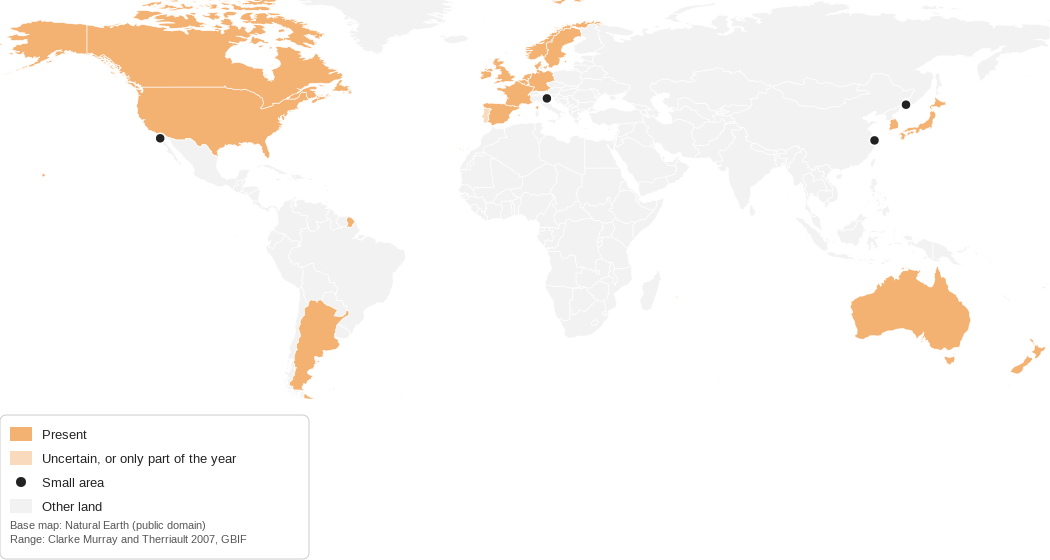
The native range lies in the north-west Pacific. It runs from the Sea of Okhotsk through southern Siberia, Japan and Korea to northern China, as far south as Shanghai.[1] The Swedish agency and NIWA name the same countries.[2][21] GBIF holds 431 records from Korea, 234 from Japan, 19 from China and 14 from Russia.[22] These counts show how much has been recorded, not how many animals live there.
Introduced range
The Stalked Sea Squirt is invasive in Europe, North America, Australia and New Zealand. The Canadian federal review names ship fouling, transfers of live oysters and fouling on fishing gear as the likely ways it was carried, with no direct proof, only the timing and pattern of the first sightings. Carrying larvae in ballast water is considered unlikely because the larva swims for a short time.[1] Inside a region it needs human help to spread, since larvae mostly settle within about 10 m of the adults.[1] The first English record, at Plymouth in 1953, coincided with warships returning from the Korean War, and hull fouling has been proposed as the cause, but this is a hypothesis.[1][13][21]
| Place | First record | Source note |
|---|---|---|
| Newport Bay, California, USA | 1933 | Thought to have arrived in the late 1920s[1][19] |
| San Francisco Bay, USA | 1949 | NEMESIS[19] |
| Beverly, Massachusetts, USA | 1970 | First on the Atlantic coast, a marina[1][19] |
| Nanaimo, British Columbia, Canada | At least 1994 | Later found at many sites in the Strait of Georgia[1][10] |
| Prince Edward Island, Canada | 1998 | First report; unpublished federal data[1][20] |
| Nova Scotia, Canada | 2012 | Southwest shore, now Cape Breton to the Bay of Fundy[10] |
| Plymouth, England | 1953 | First European record[1][2][13][21] |
| Cork Harbour, Ireland | 1971 | The Swedish agency says 1972[1][21] |
| Netherlands | 1974 | Two sources agree[1][21] |
| Belgium | 1986 | Canadian federal review[1] |
| Germany | 1997 | German Bight[1][21] |
| Spain | 2004 | Canadian federal review[1] |
| Bassin de Thau, France | 2005 | First in the Mediterranean (reported 2008)[5][13][21] |
| Chioggia, Venice lagoon, Italy | 2021 | First in the Adriatic Sea[21] |
| Sweden | July 2023 | Divers near Lysekil, west coast[21] |
Some dates differ between sources. In France the Canadian federal review gives Dieppe in 1968, and the Swedish agency says 1970.[1][21] For Denmark the review gives the mid-1960s, and the Swedish agency says the 1980s.[1][21] The Swedish agency gives Norway as 1990.[21] In Australia the first record is from Port Phillip Bay, Victoria: NEMESIS says 1972, and the review lists 1976.[1][19] The Canadian federal review lists New Zealand in 2005 (Auckland and Lyttelton).[1][22] NIWA says the species now lives in northern Tasmania, southern New South Wales and Victoria.[2] A few records exist from Argentina and Portugal.[22]
Evolution
In a dated tree built from genes, the stolidobranchs split from the branch holding salps and the other sea squirt orders about 389 million years ago (95 percent range 333 to 449 million years).[23] Stolidobranchia itself is about 350 million years old (95 percent range 292 to 416 million years), and the Styelidae split from the Pyuridae about 277 million years ago (95 percent range 218 to 343 million years).[23] That study used no tunicate fossils to set its dates, and it finds the traditional class Ascidiacea is not a natural group.[23]
Sea squirts through time
Shankouclava, from the early Cambrian of South China, resembles a modern stalked sea squirt but lacks clear sea squirt features such as paired siphons.[24] Megasiphon thylakos, from the Marjum Formation of Utah, is about 500 million years old.[24] Nanglu and colleagues place it either on the stem line of the tunicates or inside the living group; the second reading would make the split of the appendicularians about 50 million years older than the gene-based dates.[24] They found no further convincing tunicate body fossils in the two decades after 2003.[24]
Forms and variants
WoRMS, GBIF, the Catalogue of Life and ITIS list no subspecies or forms of Styela clava.[3][6][8][25] Styela mammiculata Carlisle, 1954, described as a new species from Plymouth, is a synonym.[26] Millar found in 1960 that it is the same species as S. clava.[27]
Conservation
The IUCN Red List has no assessment for the Stalked Sea Squirt. Local densities vary a lot: the species is patchy, with many animals at some sites and none at similar sites nearby.[1] A survey of Mulroy Bay in Ireland in July 2008 found more than 20 animals at one site and 5 at another, and none elsewhere in the bay.[28]
Management
Almost all management work deals with the Stalked Sea Squirt as a pest on shellfish farms outside its native range. On Prince Edward Island, Canada, the main control is to dip or spray mussel lines with a 4 percent suspension of hydrated lime (calcium hydroxide), which removes the sea squirts from the farm gear.[20] A Canadian federal science review says the rise in acidity is short-lived and reaches only a few metres from the treated gear, and that lethal effects on other animals are unlikely under current practice.[20] The same review reports that in laboratory tanks up to 75 percent of sand shrimp died, and it names the American lobster as an animal of particular concern in Malpeque Bay.[20]
Other treatments were tried on a smaller scale. In an experiment from 1988, dipping oysters in brine for 5 minutes at 14 °C, followed by 30 minutes in air, killed all the Stalked Sea Squirts with no visible effect on the oysters.[1] Growers on Prince Edward Island have also used vinegar (acetic acid) on mussel lines, with limited success.[1] A volunteer effort at a marina in Washington State, United States, removed over half a ton of animals, but the attempt failed because the population was much larger than first thought.[1]
Rules and monitoring differ by country. Fisheries and Oceans Canada watches for invasive fouling species on both Canadian coasts and asks the public to report sightings with photos, a GPS position and the date.[10] In New Zealand the species is an unwanted organism under the Biosecurity Act 1993.[2] In 2005 the New Zealand Aquaculture Council issued a voluntary code of practice that asks farmers to look for the species, remove and report it, and clean equipment and vessels before moving them.[1]
History and culture
First description
The scientific name Styela clava was given by the Scottish zoologist William Herdman in 1881, in a preliminary report on the sea squirts collected by the Challenger expedition.[8] The Canadian federal review and WoRMS use the year 1881.[1][3] A few authors write 1882 instead.[29] The Canadian federal review says Herdman described the species from dredged specimens from the Sea of Okhotsk.[1]
In 1954 the British zoologist D. B. Carlisle described a “new species”, Styela mammiculata, from four animals collected in the Plymouth area, England, in the summer of 1953.[26] Two came from a buoy at Drake’s Island in Plymouth Sound and two from oysters in the Lynher river estuary.[26] The name refers to the many small bumps (mammillae) on the tunic.[26] In 1960 R. H. Millar compared the two and concluded that they were one species, so the older name S. clava had priority.[27]
Use in Korea
A 2016 review of edible sea squirts says the Stalked Sea Squirt is a delicacy in southern Korea and has also gained a reputation there as an aphrodisiac.[4] The review gives the Korean name as “mee-duh-duck” and explains that “mee” is an old Korean word for sea and “duh-duck” is a root vegetable of similar shape.[4]
The animal is farmed there. Young animals settle on nylon nets set in shallow water, are moved to longlines, and reach market size in about a year.[4] In 1991, Korea harvested 16,966 tons of sea squirts from culture, and 9,972 tons of them were the Stalked Sea Squirt.[4] The Canadian federal review adds that it is farmed in Korea and exported to Europe and North America.[1] The 2016 review also records a proposal to harvest the species in New England and sell it fresh to Asian communities in the United States.[4]
In research, a 2023 paper presented a developmental atlas of the species and tools for changing its genes, as a base for work on how sea squirts develop.[17]
Taxonomy
| Rank | Name |
|---|---|
| Kingdom | Animalia |
| Phylum | Chordata |
| Subphylum | Tunicata |
| Class | Ascidiacea (sea squirts) |
| Order | Stolidobranchia |
| Family | Styelidae |
| Genus | Styela Fleming, 1822 |
| Species | Styela clava (Herdman, 1881) |
Synonyms (4)
| Name |
|---|
| Botryorchis clava (Herdman, 1881) |
| Tethyum clava (Herdman, 1881) |
| Styela barnharti (Ritter & Forsyth, 1917) |
| Styela mammiculata (Carlisle, 1954) |
From the GBIF backbone.[31]
Higher classification
WoRMS and GBIF place the Stalked Sea Squirt in the class Ascidiacea (sea squirts), the order Stolidobranchia and the family Styelidae.[3][8] The Catalogue of Life gives the same class, order and family, with the subphylum Tunicata above them.[6] ITIS also has the class Ascidiacea and the family Styelidae, but treats Stolidobranchia as a suborder under the order Pleurogona, and puts the group in the subphylum Urochordata.[25] A gene study found that Stolidobranchia is a natural group, the same animals as Pleurogona in older schemes.[23] The same study found that Ascidiacea is not a natural group, because salps sit inside the branch of the Phlebobranchia and Aplousobranchia.[23]
Relationships and open questions
In a study that compared eight genomes and 18 gene-activity records of styelids, the solitary Styela species (S. clava, S. plicata and S. canopus) and Asterocarpa formed the earliest branch of the family Styelidae.[30] The rest of the family split into a clade of colonial species that multiply by budding and a clade with Polycarpa, Dendrodoa and one Polyandrocarpa species.[30] The genus Polycarpa is not one branch of the tree.[30] In the larger dated tree, Styelidae and Pyuridae are sister families, and Molgulidae is their sister.[23]
Sources
- Clarke Murray, C. and Therriault, T. W. 2007. Biological synopsis of the invasive tunicate Styela clava (Herdman 1881). Canadian Manuscript Report of Fisheries and Aquatic Sciences 2807
- NIWA. Clubbed tunicate (Styela clava)
- WoRMS, Styela clava Herdman, 1881 (AphiaID 103929)
- Lambert, G., Karney, R. C., Rhee, W. Y. and Carman, M. R. 2016. Wild and cultured edible tunicates: a review. Management of Biological Invasions 7(1): 59–66
- Davis, M. H. and Davis, M. E. 2008. First record of Styela clava (Tunicata, Ascidiacea) in the Mediterranean region. Aquatic Invasions 3(2): 125–132
- Catalogue of Life, Styela clava Herdman, 1881
- iNaturalist. Styela clava (Stalked Sea Squirt)
- GBIF Secretariat, Styela clava Herdman, 1881, GBIF Backbone Taxonomy (species 2331942)
- Davis, M. H. and Davis, M. E. 2009. Styela clava (Tunicata: Ascidiacea): a new threat to the Mediterranean shellfish industry? Aquatic Invasions 4(1): 283–289
- Fisheries and Oceans Canada. Species profile: Clubbed Tunicate (Styela clava)
- Valcarcel, J. et al. 2022. Isolation and characterization of polysaccharides from the ascidian Styela clava. Polymers 14: 16
- Jiang, A.-L., Guo, J.-L., Cai, W.-G. and Wang, C.-H. 2008. Oxygen consumption of the ascidian Styela clava in relation to body mass, temperature and salinity. Aquaculture Research 39: 1562–1568
- OSPAR Commission and ICES. 2010. Quality Status Report 2010, case study: leathery sea squirt (Styela clava)
- Jiang, A., Yu, Z., Cai, W. and Wang, C. 2008. Feeding selectivity of the marine ascidian Styela clava. Aquaculture Research 39: 1190–1197
- Moon, C., Park, H., Yun, S. and Kwak, J. 2014. Food sources of the ascidian Styela clava cultured in suspension in Jindong Bay of Korea as determined by C and N stable isotopes. The Sea 19: 302–307
- Qi, Z. et al. 2015. First report on in situ biodeposition rates of ascidians (Ciona intestinalis and Styela clava) during summer in Sanggou Bay, northern China. Aquaculture Environment Interactions 6: 233–239
- Establishment of a developmental atlas and transgenetic tools in the ascidian Styela clava. 2023. Marine Life Science & Technology
- Demography and population projections of the invasive tunicate Styela clava in southern New Zealand. 2010. University of Canterbury thesis
- Smithsonian Environmental Research Center. NEMESIS: Styela clava species summary
- Burridge, L. and Comeau, L. 2016. Hydrated lime to control Styela clava in Prince Edward Island mussel farming. DFO Canadian Science Advisory Secretariat Research Document 2016/024
- Havs- och vattenmyndigheten (Swedish Agency for Marine and Water Management). 2023. Fact sheet: Styela clava (Lädersjöpung)
- GBIF.org. Occurrence records of Styela clava Herdman, 1881 (taxon 2331942), counts per country read 25 November 2026
- Delsuc, F. et al. 2018. A phylogenomic framework and timescale for comparative studies of tunicates. BMC Biology 16: 39
- Nanglu, K., Lerosey-Aubril, R., Weaver, J. C. and Ortega-Hernandez, J. 2023. A mid-Cambrian tunicate and the deep origin of the ascidiacean body plan. Nature Communications 14: 3832
- ITIS, Styela clava (TSN 159337)
- Carlisle, D. B. 1954. Styela mammiculata n.sp., a new species of ascidian from the Plymouth area. Journal of the Marine Biological Association of the United Kingdom 33(2): 329–334
- Millar, R. H. 1960. The identity of the ascidians Styela mammiculata Carlisle and S. clava Herdman. Journal of the Marine Biological Association of the United Kingdom 39(3): 509–511
- MERC Consultants. 2008. Survey of Mulroy Bay SAC for Styela clava. National Parks and Wildlife Service, Ireland
- Neish, A. 2007. Styela clava (leathery sea squirt). MarLIN, Marine Biological Association of the UK
- Alie, A. et al. 2018. Convergent acquisition of nonembryonic development in styelid ascidians. Molecular Biology and Evolution 35(7): 1728–1743
- GBIF backbone, Styela clava, synonyms