Gould’s Wild Turkey, Meleagris gallopavo mexicana, is the Wild Turkey of the mountains of north-western and north-central Mexico, with small outposts in the far south-west of the United States.[1][2] The National Park Service calls it the largest subspecies of Wild Turkey, with the longest legs and the smallest population.[2]
Names and classification
John Gould described it in 1856 as a new species, Meleagris mexicana. He argued that the domestic turkey came from Mexico, so the Mexican bird should have its own name, “mexicana, after the country of which it is a native”. The specimen had been brought to Britain by the late Mr. Floresi.[3] Nelson thought in 1900 that the type most probably came from near Bolaños in Jalisco, where Floresi had lived. This is a guess from the collector, not a label.[4][5] The IOC, the eBird/Clements checklist, AviList and GBIF list mexicana as a subspecies, with the author Gould, 1856.[1][6][7][8] New Mexico agencies spell the name “mexicanus”.[9]
In 1938 R. T. Moore named another form, onusta, from a female collected on the western slope of the Sierra Madre in Chihuahua, about 6,400 feet up. He described white tail tips, a tail barred cinnamon and black, a pure black rump with no green sheen, and a large body, calling it “the extreme dark form of the species”. The name means “burdened”, for its heavy body.[10] Moore himself thought it wiser to leave mexicana as a synonym of gallopavo until a series could be taken from Bolaños.[10] The IOC includes onusta in mexicana.[1] The 2025 eBird/Clements checklist and AviList do not keep it.[6][7]
Description
The tail and the feathers covering its base are tipped white. In 1892 Sennett noted that the Gould’s form lived only at heights of 3,000 to 10,000 feet.[11] Nelson named its marks in 1900 as a green sheen on the rump, a tail that is spotted and mottled instead of barred, and no rufous about the tail and its coverts. He found the Merriam’s form to have a velvety black rump instead.[4] The National Park Service calls it the largest subspecies of Wild Turkey and says it has the longest legs of all of them.[2]
Range
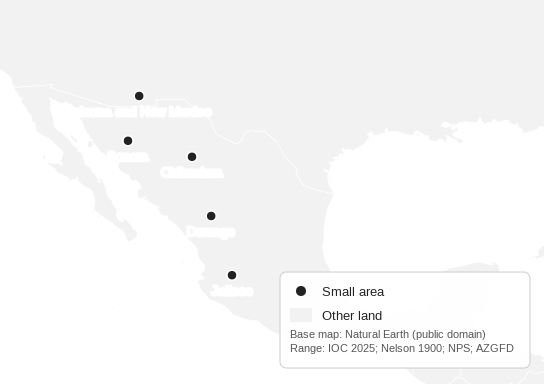
Nelson gave the range in 1900 as the Sierra Madre of western Mexico, from Chihuahua to Colima. He found birds from northern Chihuahua to be intermediate with the Merriam’s form, and typical Gould’s turkeys in southern Durango.[4] A Mexican paper lists Sonora, Chihuahua, Sinaloa, Durango, Nayarit, Zacatecas and Jalisco. It gives the habitat as steep country with canyons, at 1,000 to 3,000 metres, with water as a limit.[5] The IOC gives “north-west and north-central Mexico”.[1] In the United States the range reached the mountain “sky islands” of southern Arizona and New Mexico.[2] In Arizona the bird was native and was gone by the 1920s, until it was brought back.[12]
Classification evidence
A 2002 study of genetic markers found that the Gould’s subspecies was both the most genetically different and the least genetically varied of the subspecies it tested.[13] A 2018 study of mitochondrial DNA found a wild Gould’s group that it called ancestral and relict, with a split at about 3.39 million years ago, and proposed a spread north into Arizona and New Mexico.[14] A 2001 study found that the turkeys in the Huachuca Mountains of Arizona grouped with the old Gould’s populations of northern Mexico, and showed no sign of interbreeding with Merriam’s turkeys.[15] Mexican writers list mexicana and intermedia as the two wild forms in Mexico.[5]
History
Within 50 years of its description in 1856, Gould’s turkey had been hunted to rarity or local extinction in Arizona.[2] An international effort to restore it began in 1977. The first nine birds from Mexico were released in the Huachuca Mountains in 1983, and releases went on every few years until 2006. About 250 birds were caught in Mexico and brought to Arizona between 1983 and 2006, according to the Arizona Game and Fish Department.[12] The National Park Service gives 35 birds captured in Mexico for release in the sky islands.[2] The Peloncillo Mountains population in New Mexico was later boosted.[9]
Status
New Mexico listed it as a threatened species in 1974, because of its limited range there and uncertainty about how many there were.[9] The state’s recovery plan of April 2017 set criteria, and the department wrote in 2021 that they had been met.[9] The Game Commission voted on 15 October 2022 to remove it from the list.[16] Arizona offered its first Gould’s turkey hunting permit in 2003, since the bird had died out there.[12] In 2014 more than 1,200 turkeys were counted in Arizona and New Mexico.[2] Hunting is not allowed inside Chiricahua National Monument.[2]
Sources
- IOC World Bird List, version 15.2. Order Galliformes, family Phasianidae, Meleagris gallopavo
- National Park Service, Chiricahua National Monument. Gould’s turkey
- Gould, J. 1856. On a new turkey, Meleagris mexicana. Annals and Magazine of Natural History (series 2) 19: 107–110 (reprint)
- Nelson, E. W. 1900. Description of a new subspecies of Meleagris gallopavo and proposed changes in the nomenclature of certain North American birds. The Auk 17: 120–126
- Pérez-Arteaga, A., Zalapa, S. and Guerrero-Vázquez, S. 2019. Evidencia fotográfica del guajolote norteño (Meleagris gallopavo) en La Primavera, Jalisco. Huitzil 20(2): e511
- Clements, J. F. et al. The eBird/Clements checklist of birds of the world, v2025: Meleagris gallopavo and subspecies
- AviList: the global avian checklist, v2025
- Meleagris gallopavo Linnaeus, 1758. GBIF Backbone Taxonomy
- New Mexico Department of Game and Fish. 2021. Public comments sought on potential delisting of Gould’s wild turkey
- Moore, R. T. 1938. A new race of wild turkey. The Auk 55: 112–115
- Sennett, G. B. 1892. Description of a new turkey. The Auk 9: 167–169
- Arizona Game and Fish Department. Arizona Wildlife Conservation Strategy: Gould’s turkey reintroduction in Mexico and Arizona
- Mock, K. E., Theimer, T. C., Rhodes, O. E., Greenberg, D. L. and Keim, P. 2002. Genetic variation across the historical range of the wild turkey (Meleagris gallopavo). Molecular Ecology 11: 643–657
- Padilla-Jacobo, G. et al. 2018. Evolutionary history of Mexican domesticated and wild Meleagris gallopavo. Genetics Selection Evolution 50: 19
- Mock, K. E., Theimer, T. C., Wakeling, B. F., Rhodes, O. E., Greenberg, D. L. and Keim, P. 2001. Verifying the origins of a reintroduced population of Gould’s wild turkey. Journal of Wildlife Management 65: 871–879
- New Mexico Political Report. 15 October 2022. Game Commission votes to delist Gould’s turkey