Merriam’s Wild Turkey, Meleagris gallopavo merriami, is the Wild Turkey of the western mountains of the United States.[1] E. W. Nelson described it in 1900 from a specimen collected in Arizona.[2]
Names and classification
Nelson described Meleagris gallopavo merriami as a new subspecies in The Auk in 1900, and named it after Dr. C. Hart Merriam.[2] The type is an adult male in the U.S. National Museum, collected 47 miles south-west of Winslow, Arizona, on 9 January 1900 by E. A. Goldman.[2] The IOC, the eBird/Clements checklist, AviList and GBIF all list it as a subspecies.[1][3][4][5]
Description
Nelson told it from the Eastern bird by whitish tips on the feathers of the lower rump, the tail coverts and the tail. He told it from the Gould’s form by its velvety black rump, by more rusty rufous after the white tips on the tail and its coverts, and by distinct black and chestnut bars on the middle tail feathers.[2] The type male measured 520 mm in wing, 400 mm in tail, 41 mm in bill and 162 mm in leg. Its spurs were short and blunt, and in some birds they are missing.[2] Moore’s key of 1938 gives a cinnamon bar next to the tip of the tail feathers, and light buff tips on the upper tail coverts.[6] Colorado Parks and Wildlife describes the males as mostly black, with blue, purple and bronze reflections, and white on the lower back and the tail edges.[7]
Range
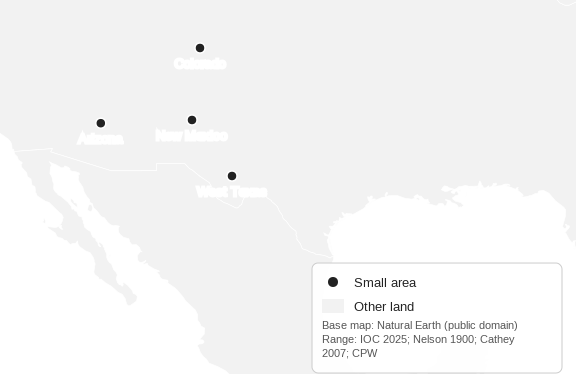
Nelson gave the range in 1900 as the mountains of Arizona and western New Mexico, south to the Mexican border and probably north into the extreme south-west of Colorado.[2] Moore gave it in 1938 as southern Colorado, Arizona, New Mexico, western Texas and northern Chihuahua east of the Sierra Madre.[6] The IOC gives “western USA”.[1] The Forest Service lists Texas, Arizona, New Mexico, Oklahoma and Colorado as the original range, after a 1976 source.[8] Colorado Parks and Wildlife calls it the native turkey of Colorado. It lives mainly in the high foothills west of Interstate 25, and may move up to 40 miles between summer and winter areas.[7] In far western Texas it has hybridized with the Rio Grande form.[9]
The National Wild Turkey Federation describes releases in Montana of 13 birds from Wyoming in 1954, 18 in 1955 and 26 in 1956 and 1957.[10]
Classification evidence
A 2002 study of genetic markers found that the subspecies based on body features were generally supported.[11] A 2001 study found that the old Merriam’s turkeys of Arizona differ consistently from the old Gould’s turkeys of northern Mexico.[12] A 2018 study of 612 mitochondrial DNA sequences found three genetic groups, and Merriam’s is the one it called C2.[13] A study of ancient DNA from turkeys of the south-west of the United States ruled out Merriam’s as the ancestor of those domestic birds.[14]
History
An estimate quoted by the National Wild Turkey Federation says that around 1942 only 39,000 Merriam’s turkeys were thought to exist across the range.[15] Colorado began an aggressive reintroduction project in the 1980s.[7] The National Wild Turkey Federation says Colorado traded Merriam’s turkeys to Idaho for 40 mountain goats.[10]
Status
Merriam’s turkey is a game bird, and the National Wild Turkey Federation says it is hunted in 14 states.[10] The same organisation, in an article of 2023, gives about 120,000 turkeys in Montana, where the bird was introduced.[10]
Sources
- IOC World Bird List, version 15.2. Order Galliformes, family Phasianidae, Meleagris gallopavo
- Nelson, E. W. 1900. Description of a new subspecies of Meleagris gallopavo and proposed changes in the nomenclature of certain North American birds. The Auk 17: 120–126
- Clements, J. F. et al. The eBird/Clements checklist of birds of the world, v2025: Meleagris gallopavo and subspecies
- AviList: the global avian checklist, v2025
- Meleagris gallopavo Linnaeus, 1758. GBIF Backbone Taxonomy
- Moore, R. T. 1938. A new race of wild turkey. The Auk 55: 112–115
- Colorado Parks and Wildlife. Turkey (species page)
- U.S. Forest Service. Fire Effects Information System: Meleagris gallopavo species review
- Cathey, J. C. 2007. Rio Grande wild turkey in Texas: biology and management. Texas A&M AgriLife Extension B-6198
- National Wild Turkey Federation. Know your wild turkey subspecies
- Mock, K. E., Theimer, T. C., Rhodes, O. E., Greenberg, D. L. and Keim, P. 2002. Genetic variation across the historical range of the wild turkey (Meleagris gallopavo). Molecular Ecology 11: 643–657
- Mock, K. E., Theimer, T. C., Wakeling, B. F., Rhodes, O. E., Greenberg, D. L. and Keim, P. 2001. Verifying the origins of a reintroduced population of Gould’s wild turkey. Journal of Wildlife Management 65: 871–879
- Padilla-Jacobo, G. et al. 2018. Evolutionary history of Mexican domesticated and wild Meleagris gallopavo. Genetics Selection Evolution 50: 19
- Speller, C. F. et al. 2010. Ancient mitochondrial DNA analysis reveals complexity of indigenous North American turkey domestication. Proceedings of the National Academy of Sciences 107: 2807–2812
- National Wild Turkey Federation. Wild turkey population history and overview (cites Mosby 1975, Kennamer et al. 1992, Tapley et al. 2007, Eriksen et al. 2015)