The Rio Grande Wild Turkey, Meleagris gallopavo intermedia, is the Wild Turkey of the southern Great Plains, from northern Texas to east-central Mexico.[1][2] It is listed as a subspecies by the IOC, the eBird/Clements checklist, AviList and GBIF.[1][2][3][4]
Names and classification
The name intermedia first appears in a text of 1879, where G. B. Sennett wrote that the turkeys of the lower Rio Grande “must be held as gallopavo, or a var. intermedia established”, and added that this second choice was “an alternative not to be desired”.[5] It was therefore only a possible variety in 1879. He had two males that weighed over 20 pounds each in the flesh.[5] Sennett gave the formal description in 1892, under a new name, Meleagris gallopavo ellioti, the “Rio Grande Turkey”, named after D. G. Elliot.[6] The types are an adult male from Lomita Ranch, Hidalgo County, Texas, collected on 13 April 1878, and an adult female from Cameron County, Texas, collected on 6 March 1888.[6] In 1894 Elliott Coues noted that a change of name would be needed if ellioti of 1892 was the same as intermedia of 1879.[7] Later authors, among them Nelson in 1900 and Moore in 1938, used intermedia.[8][9] The IOC, GBIF and the eBird/Clements checklist give the author as Sennett, 1879.[1][4][2]
Description
In 1892 Sennett described the back and rump as jet black with a silvery grey bar near the end of each feather, and the tail as mottled pale chestnut and black, tipped with a dark buff colour. He set this against the white tail tips of the Gould’s form and the dark reddish chestnut tips of the Eastern form.[6] Today the tail feathers and the feathers covering the base of the tail are described as tipped with yellowish-buff or tan, not dark brown.[10] In Moore’s key of 1938, the tips of the upper tail coverts are dirty brown.[9]
Texas A&M and Texas Parks and Wildlife give the weight of adult males in Texas as 17 to 21 pounds (7.7 to 9.5 kg) and of adult hens as 8 to 11 pounds (3.6 to 5.0 kg). Toms stand about 40 inches (102 cm) tall and hens about 30 inches (76 cm). Old toms have spurs up to 2 inches (5 cm) long, and a bird has 5,000 to 6,000 feathers. A poult weighs about 2 ounces (57 g) at hatching.[11]
Range
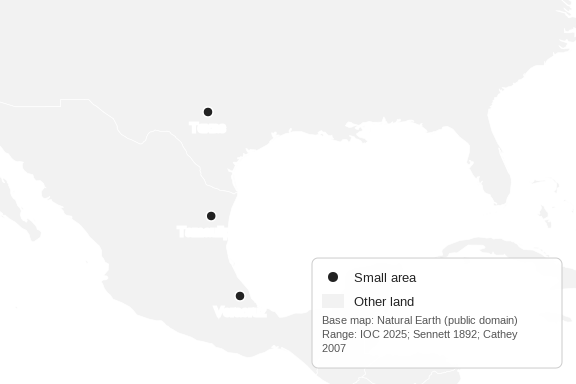
Sennett wrote in 1892 that the bird lived in the lowlands of eastern Mexico and southern Texas, not south of Veracruz, not north of the Brazos River in Texas, and not above about 2,000 feet (600 m).[6] Moore gave its range in 1938 as middle northern Texas south to Tamaulipas.[9] A Mexican paper lists it for Tamaulipas, Nuevo León, Coahuila, San Luis Potosí and Veracruz.[12] The IOC gives “northern Texas to east-central Mexico”.[1]
In Texas the stronghold is the Edwards Plateau.[11] Rio Grande and Merriam’s turkeys have hybridized in far western Texas.[11] The Forest Service lists Texas, northern Mexico, Oklahoma and Kansas as the original range, after a 1976 source.[13] In Colorado it is an introduced bird of the eastern plains.[14] In Texas and south-west Kansas, radio-tagged Rio Grande turkeys had average yearly home ranges of 1,908 hectares for females and 1,578 hectares for males.[15]
Classification evidence
Sennett noticed in 1879 that the tail-tip colour changes in a regular series, from tawny-white in the true gallopavo to dark in the Eastern bird, and that the in-between birds lived along the coast and back to the foothills from Corpus Christi in Texas to Veracruz in Mexico.[5] A 2002 study of three kinds of genetic markers across the historical range found that the subspecies based on body features were generally supported.[16] A 2018 study of 612 mitochondrial DNA sequences from Mexican wild and domesticated turkeys found three genetic groups and concluded that the data show no sub-speciation.[17]
History
Hunting cut the number of turkeys in Texas to about 100,000 by 1920, and much of the population was wiped out over its original range.[11] The National Wild Turkey Federation says market and subsistence hunting had nearly removed the bird from most of Texas by the 1880s.[10] It was restored by trapping birds and moving them, mostly from their stronghold on the Edwards Plateau.[11] Oklahoma began stocking in 1948, when biologists found no turkeys in central and western Oklahoma. That year 21 Rio Grande turkeys were caught in the Texas Panhandle and released in Harper County.[18] In Hawaii, records quoted by the National Wild Turkey Federation show releases of Texas birds in 1961 (122 birds), 1962 (224 birds) and 1963 (102 birds).[19] In 1879 Sennett noted that these turkeys roosted in tall elm, ash and hackberry trees and fed on wild tomato, insects and larvae.[5]
Status
The Rio Grande Wild Turkey is hunted in Texas, Oklahoma, Kansas and other states.[10] A Texas Parks and Wildlife estimate quoted by the National Wild Turkey Federation puts the Texas population at about 600,000 in 2022.[10] Mexico places the species in none of the categories of its risk rule, and the IUCN lists the species as Least Concern.[12][20]
Sources
- IOC World Bird List, version 15.2. Order Galliformes, family Phasianidae, Meleagris gallopavo
- Clements, J. F. et al. The eBird/Clements checklist of birds of the world, v2025: Meleagris gallopavo and subspecies
- AviList: the global avian checklist, v2025
- Meleagris gallopavo Linnaeus, 1758. GBIF Backbone Taxonomy
- Sennett, G. B. 1879. Further notes on the ornithology of the lower Rio Grande of Texas. Bulletin of the U.S. Geological and Geographical Survey of the Territories 5(3)
- Sennett, G. B. 1892. Description of a new turkey. The Auk 9: 167–169
- Coues, E. 1894. The turkey question. The Auk
- Nelson, E. W. 1900. Description of a new subspecies of Meleagris gallopavo and proposed changes in the nomenclature of certain North American birds. The Auk 17: 120–126
- Moore, R. T. 1938. A new race of wild turkey. The Auk 55: 112–115
- National Wild Turkey Federation. Know your wild turkey subspecies
- Cathey, J. C. 2007. Rio Grande wild turkey in Texas: biology and management. Texas A&M AgriLife Extension B-6198
- Pérez-Arteaga, A., Zalapa, S. and Guerrero-Vázquez, S. 2019. Evidencia fotográfica del guajolote norteño (Meleagris gallopavo) en La Primavera, Jalisco. Huitzil 20(2): e511
- U.S. Forest Service. Fire Effects Information System: Meleagris gallopavo species review
- Colorado Parks and Wildlife. Turkey (species page)
- Hall, G. I. et al. 2006. Rio Grande wild turkey home ranges in the southern Great Plains. Proceedings of the Southeastern Association of Fish and Wildlife Agencies
- Mock, K. E., Theimer, T. C., Rhodes, O. E., Greenberg, D. L. and Keim, P. 2002. Genetic variation across the historical range of the wild turkey (Meleagris gallopavo). Molecular Ecology 11: 643–657
- Padilla-Jacobo, G. et al. 2018. Evolutionary history of Mexican domesticated and wild Meleagris gallopavo. Genetics Selection Evolution 50: 19
- Oklahoma Department of Wildlife Conservation. Turkey history
- National Wild Turkey Federation. The unique history of Hawaii’s wild turkey
- BirdLife International. 2018. Meleagris gallopavo. The IUCN Red List of Threatened Species 2018: e.T22679525A132051953