Zyzzyva rufula is a small weevil, a kind of beetle, in the genus Zyzzyva. It was named by Hustache in 1951.[2] Very little has been published about it. The best-documented record is a live specimen photographed on flower buds in Mendoza Province, Argentina, in 2022.[2][3] Its genus name is famous as the last entry in several English dictionaries.[4]
Quick facts
Description
Z. rufula is a small, rounded weevil with a reddish-brown head and thorax and a body covered in pale, speckled scales. It has a long, thin, dark beak that curves downward, and slender pale legs.[3]
It has been seen resting on flower buds in the evening in a dry region of Argentina.[3] Little else is known about how it lives.
Name
Rufula is a Latin word meaning "reddish". The author's own reason for choosing it is not known.
The genus name is the famous part. Casey gave no reason for it.[1] Three explanations circulate, and none is documented by him: it echoes Zyza, a former leafhopper genus; it imitates a sound the weevil makes; or it was a joke, chosen "to have the last word". The Oxford English Dictionary lists all three as possibilities.[4] The "joke" idea comes from an unnamed entomologist quoted in a 1981 newspaper column.[7]
It is pronounced ZIH-zih-vuh.[4]
Body
No measurements of this species were found. For the genus as a whole, the original description says the body is broad, oval and covered in dense scales, with a short, thick beak and flat, triangular jaws.[1] That description was written for a different species, Z. ochreotecta, so it may not match Z. rufula exactly.
Habitat and range
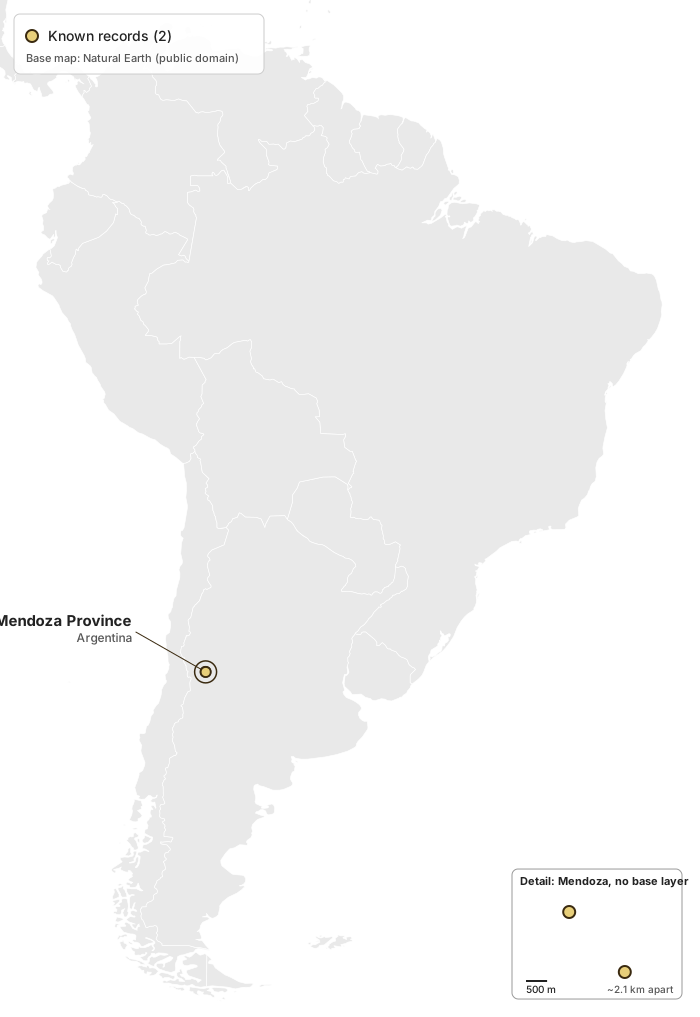
The only records are two sightings on 3 February 2022 in Mendoza Province, Argentina (at Rodeo de la Cruz and in Guaymallén), by the same observer. There are no museum or literature records.[2][3] Mendoza is a dry region. With so few records, the real range could be much larger.
History and culture
The connection to people comes from the genus name, not from the weevil itself. Nothing is known about any cultural role of Z. rufula.
Zyzzyva has become famous as a "last word". Until June 2017 the last entry in the Oxford English Dictionary was zythum, a kind of malt beer brewed in ancient Egypt. With that month's update the last entry became Zyzzyva, which the dictionary defines as a genus of tropical weevils.[4] It was already the final word in several other English-language dictionaries, and most of its fame comes from that position.[4]
The name has been borrowed twice for the same reason. Michael Thelen named his word-study program for Scrabble players Zyzzyva because the word is rarely played in a game and was the last word alphabetically at the time, so he could call it "the last word in word study".[10] A San Francisco literary magazine called ZYZZYVA, founded in 1985 by Howard Junker, uses the motto "The Last Word".[7]
Taxonomy
| Rank | Name |
|---|---|
| Kingdom | Animalia |
| Phylum | Arthropoda |
| Class | Insecta |
| Order | Coleoptera (beetles) |
| Family | Curculionidae (weevils)[2] |
| Subfamily | Baridinae[8] |
| Genus | Zyzzyva Casey, 1922 |
| Species | Zyzzyva rufula Hustache, 1951 |
Sources disagree on the tribe: Wikipedia gives Madarini, and the Brazilian fauna catalogue gives Eutoxini, so it is left out.[2][7]
Hustache described the species in 1951, probably in Nouveaux Barinae sud-américains (Boletim do Museu Nacional, Rio de Janeiro, Zoologia no. 96), although this is not confirmed. Its type locality, size and colour are not available online.
The genus Zyzzyva
The American entomologist Thomas Lincoln Casey Jr. described the genus in 1922 from a single male collected at Santarem, Brazil.[1] Besides Z. rufula, it has two other named species, Z. ochreotecta Casey, 1922 (the type species) and Z. squamosa (Boheman, 1844; some sources give 1836), and at least one undescribed species in Panama whose larvae live in palm seeds.[2][5][6]
Sources
- Casey, T. L. 1922. Memoirs on the Coleoptera 10, pp. 369–370 (original genus description; the archive.org scan is dated 1924 for the whole volume)
- GBIF, Zyzzyva Casey, 1922 (taxonomy and records)
- iNaturalist observation 106098766, Quentin Vandemoortele (species proposed by one identifier in 2022 and agreed by the observer)
- Oxford English Dictionary, new words notes, June 2017
- Gripenberg et al. 2019, Ecology Letters 22: 1638–1649 and the project data
- Catalogue of Life, Zyzzyva
- Wikipedia, Zyzzyva (secondary)
- Open Tree of Life, taxonomy and synthetic tree (placement of the genus)
- McKenna et al. 2009, PNAS, weevil origins and ages
- NASPA, Zyzzyva FAQ (the Scrabble program)