The Labrador Retriever is a gundog from Great Britain. The FCI describes it as strongly built, short-coupled and very active, with a good temper and a strong will to please.[1]
The breed standard
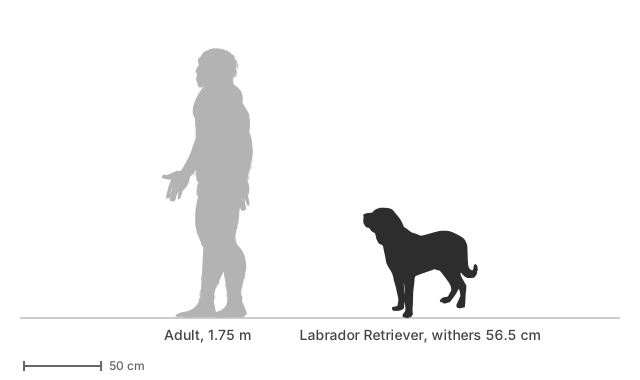
The FCI standard gives an ideal height of 56–57 cm for males and 54–56 cm for females. It sets no weight. The coat is short and dense, without wave or feathering, over a weather-resistant undercoat. The colour is wholly black, yellow or liver/chocolate. The tail is very thick at the base and tapers towards the tip, and is called the “otter” tail.[1] In a study of UK veterinary records, adult Labradors averaged 33.0 kg, with males at 35.2 kg and females at 30.4 kg. Black was the commonest colour (44.6%), then yellow (27.8%) and chocolate (23.8%).[2]
Name and origin
The FCI says it is popularly thought that the breed began on the coast of Newfoundland, where fishermen used a similar dog to retrieve fish. It adds that the Labrador is not a very old breed: its breed club was formed in 1916, and the dogs were introduced to Britain in the late 1800s by Col Peter Hawker and the Earl of Malmesbury.[1] The Royal Kennel Club (UK) says Newfoundland dogs helped fishermen retrieve nets and lost lines, and that crossing them with hunting dogs taken there by English traders and fishermen is thought to have formed the basis of the modern breed. It says the Earl of Malmesbury gave the breed its name.[3] This Newfoundland origin is traditional history rather than a DNA finding. The American Kennel Club recognised the breed in 1917.[4]
Health and lifespan
A study of Labradors under UK primary veterinary care found a median longevity (age at death) of 12.0 years. The commonest disorders were ear infection (10.4%), overweight or obesity (8.8%) and degenerative joint disease (5.5%).[2] In that study, chocolate Labradors had a shorter median age at death (10.7 years, 34 dogs) than non-chocolate ones (12.1 years, 139 dogs). The samples were small and the result comes from one UK study.[2] A separate study of UK veterinary records built life tables for 18 breeds. For the Labrador, life expectancy at birth was 11.77 years.[5]
Behavior
In an owner-reported survey of 349 Labrador Retrievers, 2.3% were reported to have snapped, bitten or tried to bite an unfamiliar person in the recent past, 1.7% a member of the household and 4.3% an unfamiliar dog. The averages across the 33 breeds in the survey were 4.7%, 2.0% and 10.7%.[6] The authors list Labrador Retrievers among the breeds least aggressive towards both people and dogs.[6] Breed explains only about 9% of behavioural differences between individual dogs, so an individual’s behaviour can differ a lot from the breed’s average.[7]
Popularity
The Labrador Retriever ranked 2nd on the American Kennel Club’s list of most popular breeds in 2025. The list counts US registrations only.[8]
Sources
- FCI breed standard 122, Labrador Retriever
- McGreevy et al. 2018, Canine Genetics and Epidemiology, Labrador retrievers under primary veterinary care in the UK
- Royal Kennel Club (UK), Labrador Retriever breed page
- American Kennel Club, breeds by year recognized
- Teng et al. 2022, Scientific Reports 12 (life tables by breed)
- Duffy, Hsu & Serpell 2008, Applied Animal Behaviour Science 114: 441–460
- Morrill et al. 2022, Science 376 (breed and behaviour)
- American Kennel Club, most popular dog breeds of 2025