The Shih Tzu is a small companion dog with a long coat and a “chrysanthemum-like” face. The FCI lists its origin as Tibet (China): its roots are in Tibet, but it was developed in China, where such dogs lived in the imperial palaces.[1]
The breed standard
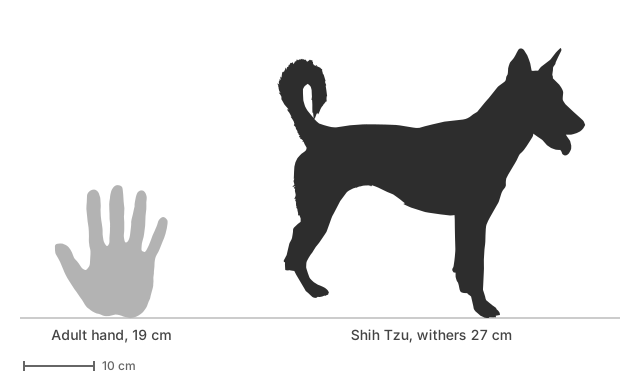
The FCI standard asks for a sturdy, abundantly but not excessively coated dog with an arrogant carriage. Height at the withers is not more than 27 cm and weight is 4.5–8 kg, with 4.5–7.5 kg ideal. The muzzle is short and square but “not wrinkled”, the eyes are large and “not prominent”, and the tail is heavily plumed and carried over the back.[1] The outer coat is long and dense, not curly, and the hair must not affect the dog’s ability to see. All colours are allowed except merle.[1] The standard calls the temperament intelligent, active and alert, friendly and independent.[1]
Name and origin
According to the FCI, the first recorded importation to Britain was in 1931. The breed was recognised as separate from other Oriental breeds in 1934, and the Kennel Club gave it a separate register in 1940.[1] The Kennel Club (UK) says it is popularly accepted that the breed originated in China with an ancestry of Tibetan breeds, and that it was once known as the Lhasa Lion Dog.[2] A study of breed relationships shows the Shih Tzu as the representative of an “Asian Toy” group of breeds.[3]
Health and lifespan
A study of Shih Tzus under UK veterinary care in 2016 followed 11,082 dogs. Their mean adult bodyweight was 7.9 kg. In a random sample of 2,423, the commonest disorders were periodontal disease (9.5%), anal sac impaction (7.4%) and ear disorders (5.5%). Among the Shih Tzus that died in the study year, the median age at death was 12.7 years. The authors note a higher prevalence of anal sac impaction, umbilical hernia and eye problems than reported for dogs overall, and that the breed is considered brachycephalic (short-faced).[4]
In a separate UK life-table study of veterinary records, life expectancy at birth for the Shih Tzu was 11.05 years (95% confidence interval 10.73–11.40).[5] The two figures measure different things and come from different studies, so they should not be compared directly.
Popularity
The AKC recognised the Shih Tzu in 1969.[6] The Shih Tzu ranked 21st on the AKC’s list of most popular breeds in 2025.[7]
Sources
- FCI breed standard 208, Shih Tzu
- The Kennel Club (UK), Shih Tzu breed page
- Parker et al. 2017, Cell Reports 19: 697–708
- Dale et al. 2024, Canine Medicine and Genetics 11: 2 (Shih Tzus under UK veterinary care)
- Teng et al. 2022, Scientific Reports 12 (life tables by breed, UK veterinary records)
- American Kennel Club, breeds by year recognized
- American Kennel Club, most popular dog breeds of 2025