Apis mellifera cecropia is the Greek honey bee, a subspecies of southern Greece including the Peloponnese.[1]
Names and classification
Kiesenwetter named it in 1860 as a variety, Apis mellifica cecropia, in a paper on the bees of Mount Hymettus (Berliner Entomologische Zeitschrift 4: 315–317).[2] Engel lists no synonyms for it. The name hymettea, which Pollmann gave in 1879, is treated as a replacement name for carnica.[2] It belongs to lineage C.[1][3]
Range
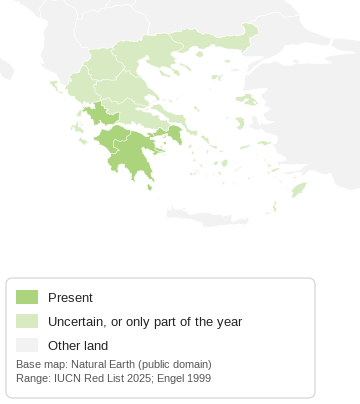
The IUCN gives the range as southern Greece, including the Peloponnese.[1] Engel gives most of Greece and the surrounding Aegean islands, meeting macedonica in the north-east and carnica in the north-west corner of the country.[2]
Classification evidence
In 2020 a complete mitochondrial genome was still missing for cecropia.[4]
Status
Accepted: it is one of the ten subspecies of Apis mellifera that the IUCN’s 2025 assessment for Europe (Moro et al.) recognises.[1]
BeeBreed.eu says the subspecies is highly endangered by hybridisation and replacement.[5]
Sources
- Moro et al. 2025, Apis mellifera (Europe assessment), The IUCN Red List of Threatened Species 2025: e.T42463639A277757621 (assessed 17 July 2025)
- Engel 1999, “The taxonomy of recent and fossil honey bees (Hymenoptera: Apidae; Apis)”, Journal of Hymenoptera Research 8(2): 165–196
- Ilyasov, Lee, Takahashi, Kwon and Nikolenko 2020, “A revision of subspecies structure of western honey bee Apis mellifera”, Saudi Journal of Biological Sciences 27(12): 3615–3621
- Tihelka, Cai, Pisani and Donoghue 2020, “Mitochondrial genomes illuminate the evolutionary history of the Western honey bee (Apis mellifera)”, Scientific Reports 10: 14515
- BeeBreed.eu, Institute for Bee Research, pages on the subspecies