Apis mellifera iberiensis is the Iberian honey bee, the subspecies of Spain, Portugal and the Balearic Islands.[1]
Names and classification
Engel named it in 1999 as a replacement for Apis mellifera iberica Ruttner, 1988, because Skorikov had already used iberica in 1929 for a bee from Azerbaijan.[2] Engel chose as neotype a worker collected near Córdoba, Andalusia, Spain, in September 1986.[2] The lineage is debated. Ruttner placed it in the M lineage with mellifera, and Ilyasov and colleagues also give M.[3][4] Tihelka and colleagues note that molecular studies show much admixture with the African A lineage, especially in the south of the peninsula, and some authors have assigned it to A.[5]
Range
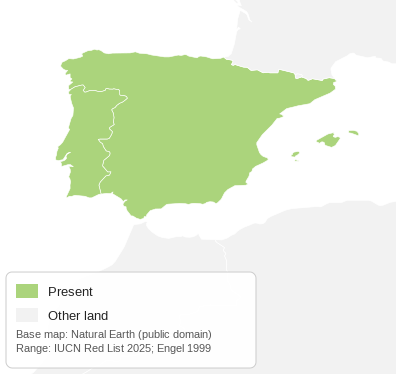
The IUCN gives the range as the Iberian Peninsula and the Balearic Islands.[1] Engel says it occurs naturally on the Iberian Peninsula, and that colonies sent to tropical South America never became established.[2] Ilyasov and colleagues give Spain and Portugal.[4]
Classification evidence
Chavez-Galarza and colleagues found two main genetic groups across Iberia, along a north-east to south-west line, which fits contact between populations that survived the ice ages in separate refuges.[6] Wing shape of 711 colonies follows the same genetic structure as the SNP markers.[3] In mitochondrial genomes, iberiensis and the north-west African sahariensis are sister groups.[5]
Status
Accepted: it is one of the ten subspecies of Apis mellifera that the IUCN’s 2025 assessment for Europe (Moro et al.) recognises.[1]
Chavez-Galarza and colleagues found that, despite intense beekeeping, human moves have had only a small part in shaping the genetic structure of Iberian honey bees. They stress the value of Iberia as a store of honey bee diversity.[6]
Sources
- Moro et al. 2025, Apis mellifera (Europe assessment), The IUCN Red List of Threatened Species 2025: e.T42463639A277757621 (assessed 17 July 2025)
- Engel 1999, “The taxonomy of recent and fossil honey bees (Hymenoptera: Apidae; Apis)”, Journal of Hymenoptera Research 8(2): 165–196
- Henriques, Chavez-Galarza, Quaresma et al. 2020, “Wing geometric morphometrics of workers and drones and single nucleotide polymorphisms provide similar genetic structure in the Iberian honey bee (Apis mellifera iberiensis)”, Insects 11: 89
- Ilyasov, Lee, Takahashi, Kwon and Nikolenko 2020, “A revision of subspecies structure of western honey bee Apis mellifera”, Saudi Journal of Biological Sciences 27(12): 3615–3621
- Tihelka, Cai, Pisani and Donoghue 2020, “Mitochondrial genomes illuminate the evolutionary history of the Western honey bee (Apis mellifera)”, Scientific Reports 10: 14515
- Chavez-Galarza, Garnery, Henriques et al. 2015, “Revisiting the Iberian honey bee (Apis mellifera iberiensis) contact zone”, Molecular Ecology 24