Apis mellifera ruttneri is the Maltese honey bee, a small, wide-bodied subspecies of Malta and Gozo.[1][2]
Names and classification
Sheppard, Arias, Grech and Meixner described it in 1997 as a new subspecies, in Apidologie 28(5): 287–293.[1] They named it for Friedrich Ruttner, who contributed so much to honey bee taxonomy.[1] They sampled 15 colonies at 8 apiaries throughout Malta, and named no single type locality.[1] It belongs to lineage A, the African lineage.[3][4]
Description
It is about the size of the Sicilian bee and of intermissa, but with shorter legs and much narrower wings. The abdomen is considerably wider (sternum index 77.74, against 81.52 in intermissa), which makes it the broadest subspecies of Apis mellifera described, broader even than mellifera (78.61).[1] Its colour does not differ much from that of intermissa and siciliana, and it has considerably longer hair on the abdomen.[1]
Behaviour
The describers report, from unpublished beekeeper data, that it finds food and water in the dry months from April to September, rears brood all year and raises up to 80 queen cells before swarming. It defends itself against the local predatory wasps, and is more defensive at low humidity.[1] In a 2023 comparison of 15 colonies with 18 colonies of imported ligustica, ruttneri scored acceptably for gentleness and calmness on the comb, and its colonies survived significantly longer.[5]
Range
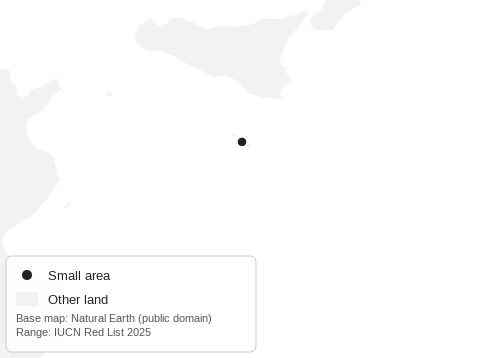
It lives on Malta and on Gozo.[1][3][2]
Classification evidence
In the describing paper, Maltese bees fell close to siciliana and intermissa and far from the Cretan bee and the Italian and Carniolan bees. Their mitochondrial DNA matched that of the African and Sicilian bees, and contamination with Italian bees could be ruled out.[1] A 2017 study using 33 parameters found that 32 colonies matched the original description. Haplotypes A4, A8 and A9 were found in 83% of the colonies.[6] A newer method separates unhybridised ruttneri from hybrids.[7]
History
The describers already wrote that wild colonies had been lost to the Varroa mite, and that the chance of the subspecies disappearing was very high.[1] Later work says its status is uncertain after Varroa outbreaks followed by ill-conceived replacement programmes.[6]
Status
Accepted: it is one of the ten subspecies of Apis mellifera that the IUCN’s 2025 assessment for Europe (Moro et al.) recognises.[3]
Janczyk and colleagues call it endangered by hybridisation with subspecies that beekeepers often import.[7] Uzunov and colleagues describe a tiny population, and name the import of commercial non-native stock as the most prominent threat.[5] A 2025 study of 34 colonies on Gozo and 21 on Malta found clear signs of hybridisation on both islands.[2]
Sources
- Sheppard, Arias, Grech and Meixner 1997, “Apis mellifera ruttneri, a new honey bee subspecies from Malta”, Apidologie 28(5): 287–293
- Farrugia 2025, wing morphometrics of honey bees of Gozo and Malta, Journal of Apicultural Science
- Moro et al. 2025, Apis mellifera (Europe assessment), The IUCN Red List of Threatened Species 2025: e.T42463639A277757621 (assessed 17 July 2025)
- Ilyasov, Lee, Takahashi, Kwon and Nikolenko 2020, “A revision of subspecies structure of western honey bee Apis mellifera”, Saudi Journal of Biological Sciences 27(12): 3615–3621
- Uzunov, Mifsud, Galea, Cutajar and Zammit-Mangion 2023, Apidologie 54(4)
- Zammit-Mangion, Meixner, Mifsud, Sammut and Camilleri 2017, Journal of Apicultural Research 56(5): 514–522
- Janczyk, Meixner and Tofilski, Journal of Apicultural Research 60(1): 157–164