The Sea Otter (Enhydra lutris) is a small marine mammal that lives along the coasts of the North Pacific, from Russia across Alaska and Canada to California.[1] It has no blubber. Thick fur that holds air against the skin keeps it warm, and it eats about a quarter of its body weight each day.[2][3] By eating sea urchins, it helps protect kelp forests.[4] Fur-trade hunting nearly wiped it out, and fewer than 2,000 animals are thought to have survived in 1911.[1] It is listed as Endangered on the IUCN Red List.[1]
Quick facts
Description
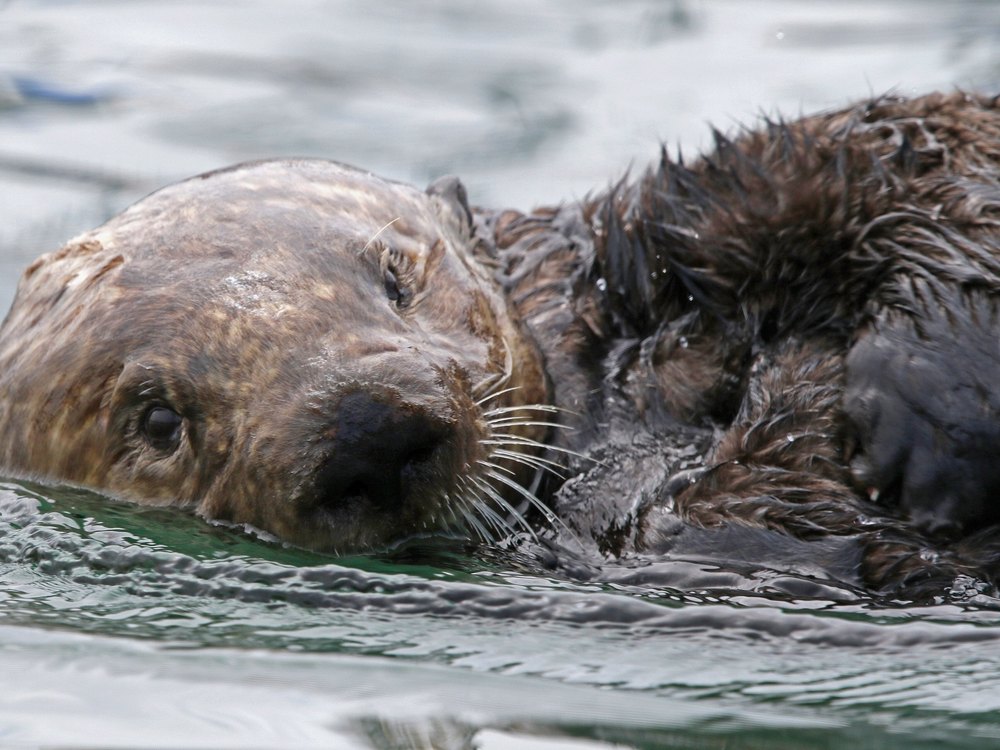
An adult Sea Otter is brown, and with age the fur of the head, neck, chest and forelimbs can turn pale and grizzled.[6] It keeps warm with dense fur that traps air, not with blubber.[2][3] It floats at the surface and eats there, often lying on its back.[2][7] It has 32 teeth, and its rounded, flat molars crush hard-shelled prey.[6] A loose fold of skin under each foreleg works as a pouch for food collected on a dive.[3]
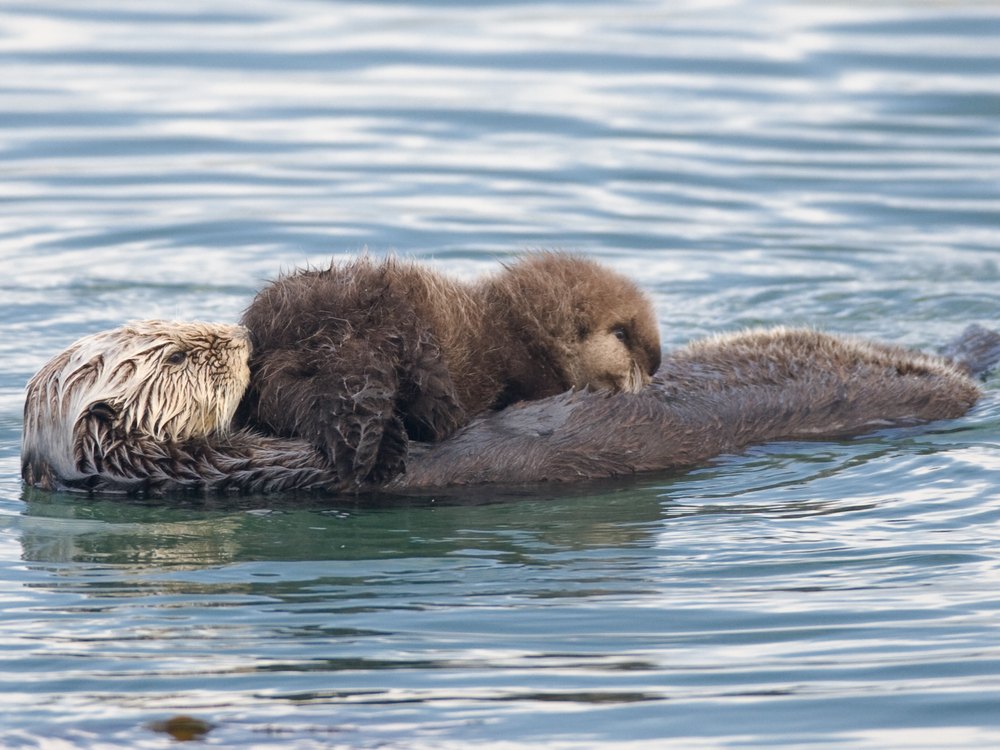
A newborn pup has woolly light-brown or yellowish fur. Adult fur has replaced it by about 13 weeks.[6]

Name
The genus name Enhydra comes from the Greek en, “in”, and hydor, “water”. The Greek word enydris means “otter”. The species name lutris comes from the Latin word for otter.[8] Those are dictionary etymologies: the reason Fleming chose the genus name is not recorded in the sources.
Linnaeus described the species in 1758 as Mustela lutris, and gave its home as “Asia & America septentrionali”, northern Asia and America.[9][10] It was moved to the new genus Enhydra (Fleming, 1822).[11][12]
In other languages
| Language | Name | Meaning |
|---|---|---|
| Russian | калан (kalan) | Said to come from a Koryak word |
| Japanese | ラッコ (rakko) | A word that probably comes from Ainu |
| Chinese | 海獎 (hǎi tǎ) | Sea otter |
| Korean | 해달 (haedal) | Sea otter |
| Spanish | nutria marina | Sea otter |
| French | loutre de mer | Sea otter |
| German | Seeotter | Sea otter |
| Italian | lontra marina | Sea otter |
| Portuguese | lontra-marinha | Sea otter |
| Dutch | zeeotter | Sea otter |
| Finnish | merisaukko | Sea otter |
| Turkish | deniz samuru | Sea sable |
Names are from the Catalogue of Life, as listed by GBIF, and the origins of the Russian and Japanese words from the Wiktionary entry and a study of the Japanese trade.[11][8][13] Names in Indigenous languages are not listed because no reliable source was found.
Body
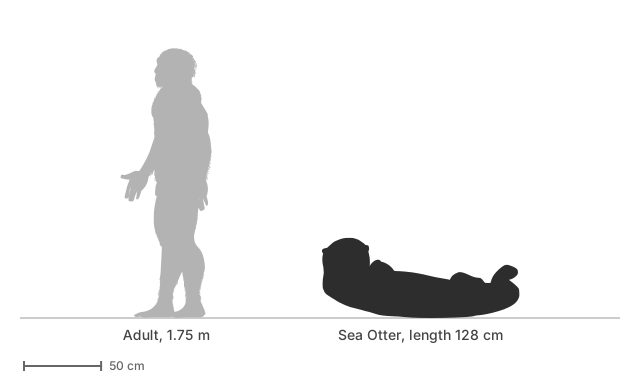
Males are larger than females. In Canada, adult males reach about 46 kg and 148 cm in total length, and adult females about 36 kg and 140 cm.[6] In California, adult females weigh about 15–36 kg and adult males 14–40 kg, so the two ranges overlap.[5] For the southern Sea Otter, the U.S. Fish and Wildlife Service gives average weights of 46 pounds for adult females and 64 pounds for adult males, about 21 kg and 29 kg.[3] Northern Sea Otters grow larger than southern ones.[5] The Sea Otter is among the smallest marine mammals.[3]
Measured adults from the California coast were 105.0–128.0 cm long (females) and 118.3–138.0 cm (males). The fitted adult lengths were 115.5 cm for females and 126.4 cm for males.[14] The study does not say whether the tail is counted. The figures are probably measured without the tail, so they should not be compared directly with the Canadian ones.[14][5]
Size also depends on food. Otters in newly occupied habitat, where food was not scarce, were heavier than those in crowded populations near their limit, by up to 28% for males and 16% for females.[6]
Fur
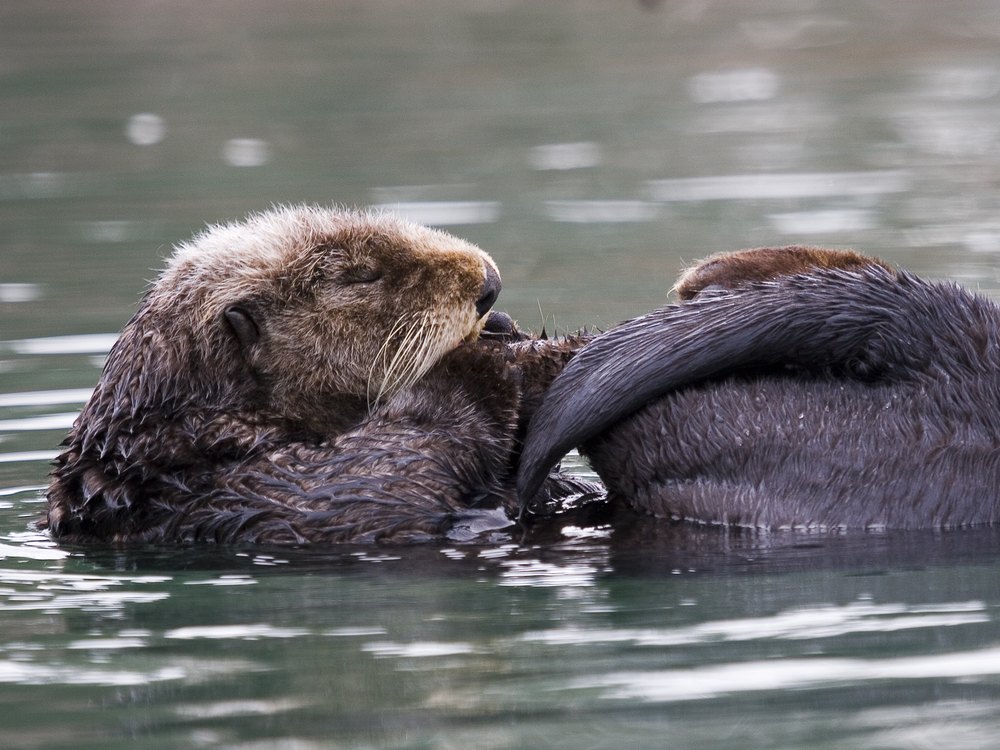
Each hair follicle bundle has one long guard hair and many fine underhairs, from 12 on the legs to 108 on the middle of the side. Guard hairs are 44–106 micrometres thick and underhairs about 10 micrometres.[15] The number of hairs depends on the part of the body, from about 26,400 per square centimetre on the feet to about 164,700 on the forearms.[15] The underfur is often given as about 100,000 hairs per square centimetre.[6] About 70% of the insulation comes from the layer of air held in the fur.[16] A newborn pup has as few as a quarter of the hairs of an adult, but its guard hairs are longer and trap a thicker layer of air.[16]
The fur is kept clean by grooming. The otter rubs it with its forepaws and hind flippers to keep the underhairs interlocked and spread natural oils.[15] Adults spent about 7% of their time grooming in one Alaskan bay.[17]
Teeth
In California, tooth wear starts at about age 3, tooth condition falls sharply by ages 7 to 8, and the adult teeth work for 13 to 17 years at most. The permanent teeth are all in place at about 9 months.[14] Otters that use tools reach larger or harder prey, and they have less tooth damage.[18]
Keeping warm
A Sea Otter has little body fat: one adult female had 1.8% of her body mass as fat.[5] Its metabolic rate is 2.4 to 3.2 times that of land carnivores of the same size.[2] A study of sea otter muscle found that its heat production is about three times what would be expected for an animal of its size, and that the muscle itself can account for it.[19] Body temperature is about 38.1 °C, and the lowest air temperature at which it stays warm without extra effort is 20 °C.[16]

Senses
Sea Otters find prey on the sea floor mainly by touch, with their whiskers and forepaws, even in poor light.[7][3]
Genome
The first genome of a northern Sea Otter was published in 2017. It is 2.426 billion base pairs long, and it was the first marine mammal genome from the weasel family.[20] Both the northern and southern Sea Otter have very little genetic variation: about 0.0003 variable sites per base pair, half the figure for the giant otter.[21]
Behavior
Social life
Sea Otters are polygynous: a male pairs with several females in turn. Males and females live in separate areas for most of the year. In summer and fall, breeding males leave the male areas to hold territories in the female areas, and later rejoin the males.[2] Otters rest in groups called rafts.[7] Females raise the pup alone, with no help from the male.[17] Sea Otters do not migrate. They stay in small, overlapping home ranges of a few to tens of kilometres of coast.[2] A range grows when males move into empty habitat first, and females follow slowly.[2]
Resting
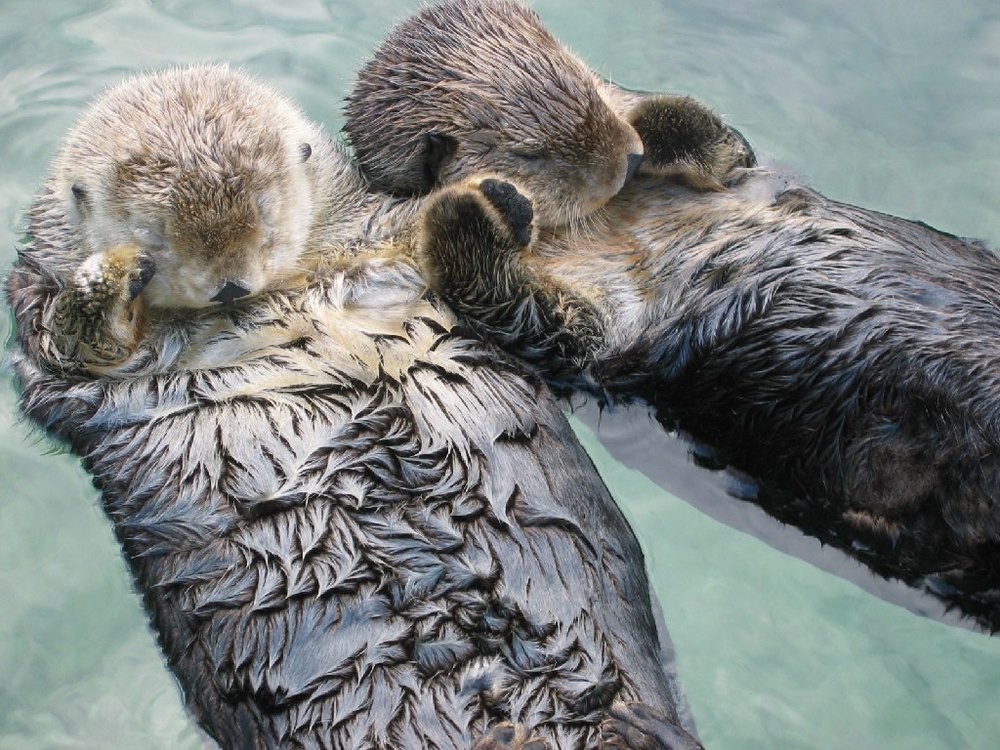
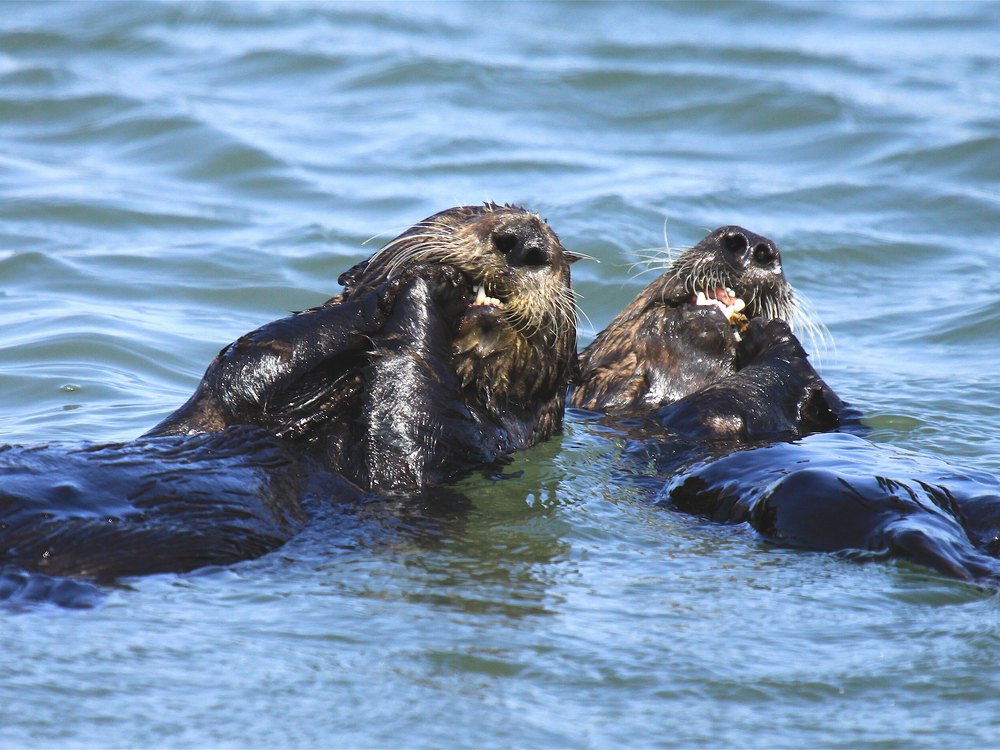
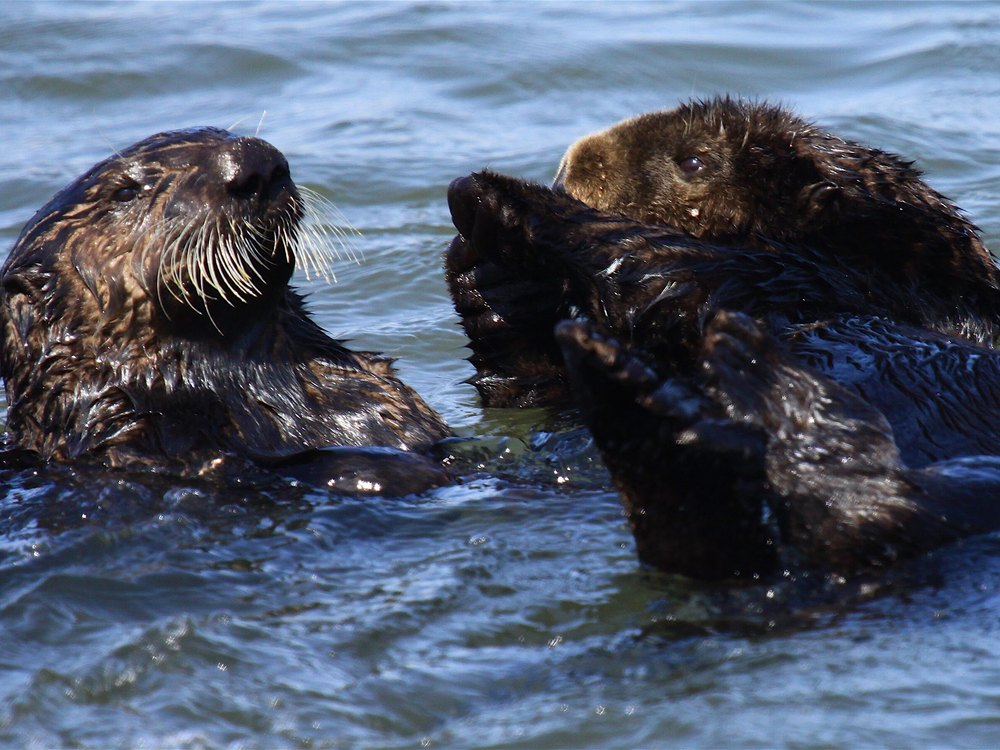
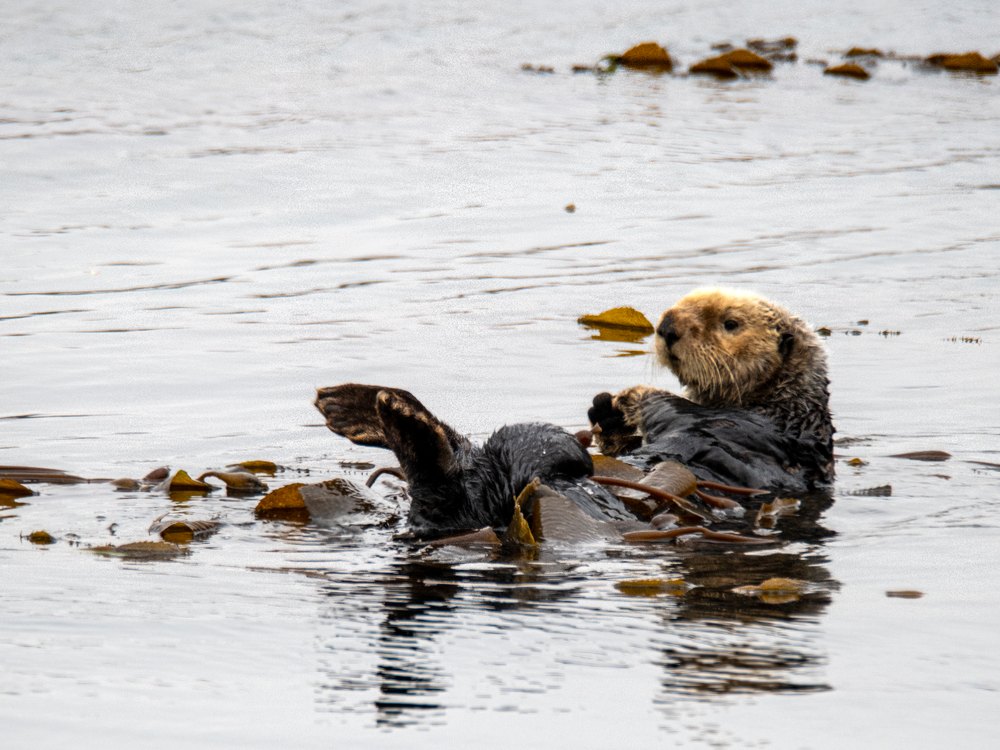
Otters rest at the surface, and often wrap themselves in kelp or seagrass so that they do not drift away.[3] Two otters have also been filmed and photographed asleep side by side holding paws at the Vancouver Aquarium, and a video of this from 2007 spread widely. A popular-science article says that holding paws is rare, especially in the wild, but it names no study of how often it happens.[22] A pup stays afloat while its mother dives, held up by the air in its woolly natal fur.[17]

Daily rhythm
Activity differs between places. Off central California, feeding was mostly at dawn and dusk, with larger afternoon peaks.[23] In one study in southeast Alaska, otters spent 37% of the day foraging (about 8.9 hours), 11% on other dives and 52% not diving.[24] Females with large pups forage for about 48–50% of the time.[5]
Tool use
Sea Otters crack hard-shelled prey with rocks, sometimes resting the prey on the chest and hitting it.[7] In a study of 196 radio-tagged southern Sea Otters, tool users, especially females, reached larger or harder-shelled prey and had less tooth damage.[18]
Voice
A study of wild and captive California otters found 10 basic kinds of call. The scream call identified individuals: the producer was matched with 80% accuracy for mothers and 75% for young. The calls seem suited to short-range talk between animals that know each other.[25]
Diet
The Sea Otter is a carnivore. It eats more than 100 kinds of prey, mostly animals without backbones that live on the sea floor: sea urchins, clams and other bivalves, snails, chitons, crabs and sea stars. In some regions it also eats fish.[2] It eats about 20–30% of its body weight each day.[2][5][3] It digests about 82% of what it eats.[5]
Changing menus
Where prey is plentiful, otters take large, easy prey such as sea urchins. As these become scarce, the diet widens to bivalves, snails, chitons, crabs, sea stars and fish.[2] Fish are important in parts of the Aleutian, Commander and Kuril Islands.[2] In California, two sites differed: marine snails and sea urchins were the main prey at the central coast and San Nicolas Island, and the rate of food intake at San Nicolas Island was more than twice that off the central coast.[26]
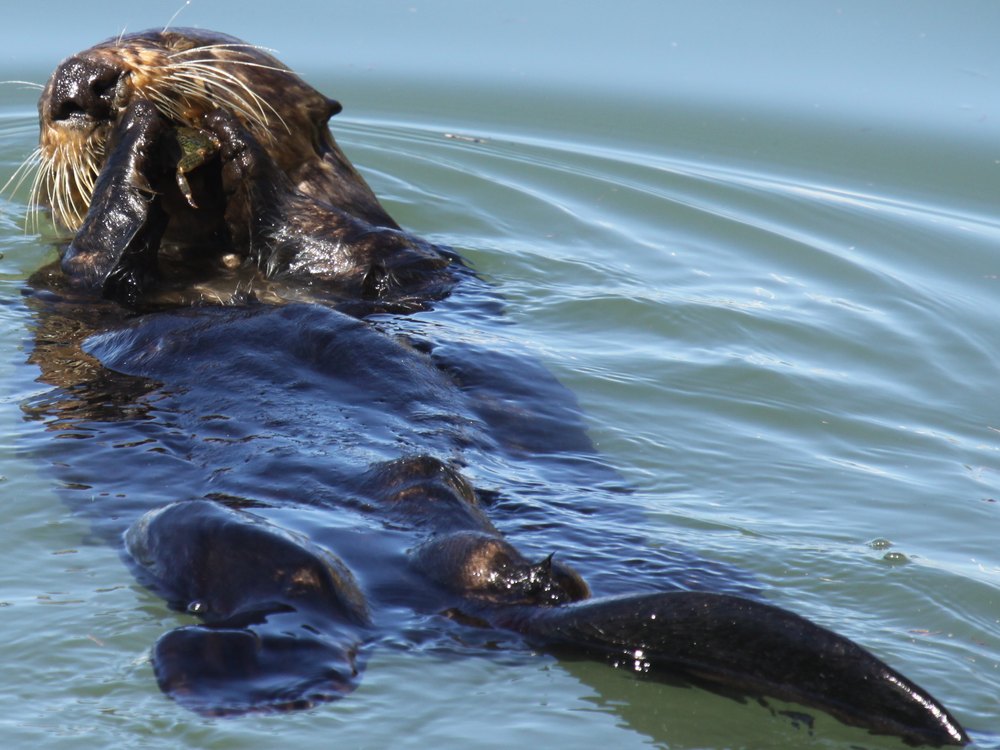

Individual tastes
Ten adult females in Monterey Bay, sharing one area, had large and lasting differences in diet. The authors think the habits are learned, and passed down from mother to young.[27] Where food is scarce, specialists handled about 25% more items per unit of time than non-specialists.[26]
Diving
Most foraging happens at depths of 40 m or less, and otters can dive to about 100 m.[2] In southeast Alaska, time-depth recorders on 14 otters logged 180,848 dives. Most foraging dives were between 2 and 30 m, and fewer than 2% went deeper than 55 m. Females mostly stayed shallow, while males often dived to 45 m or more.[28] The U.S. Fish and Wildlife Service says most dives by southern Sea Otters are shallower than about 24 m.[3] A foraging dive lasts from about 50 seconds to over 3 minutes.[2] Prey is eaten at the surface.[2]
Life cycle
| Stage | Time | Notes |
|---|---|---|
| Newborn pup | About 0–4 weeks | Born in the water, 1.4–2.3 kg. It cannot swim or groom, has dense natal fur and rests about 83% of the day[2][17] |
| Dependent pup | About 4–12 weeks and beyond | Starts to swim, then dives briefly, and moults the natal fur. Adult fur is complete by about 13 weeks. Begins to forage at about day 63[17][6][5] |
| Weaned juvenile | About 5–8 months to 3–5 years | Weaned at about 6 months. The skeleton is still growing: growth plates close between about 0.7 and 3 years[2][14] |
| Adult | From about 3–5 years (females) and 5–6 years (males) | Females breed from 3 to 5 years; males breed at about 5–6, and often not until they hold a territory[2] |
Mating and pregnancy
Sea Otters mate and give birth all year round. Some regions have a spring peak, but sources disagree about the peak in California, so the timing varies by place.[2][29][30] Once the embryo has implanted, pregnancy lasts about 217–218 days.[31][30] Before that, implantation is delayed, but how long the delay lasts is not known. Two estimates are 7–8 months and only 2–3 months.[31] A female has one pup. Twins are about 2% of births, and a mother can usually raise only one.[31][2] In Monterey Bay, the mean time between births was 407 days.[29]
Pup care and weaning
The pup is born at sea. It is the most helpless young of any marine mammal, and cannot swim for 4 to 6 weeks.[17] The mother carries it on her chest, grooms it, and leaves it floating at the surface while she dives.[17] In Alaska, a pup of 8 to 12 weeks was over 75% of its mother’s length and made short, shallow dives. Nursing took about 7–8% of the pup’s time at all ages. The mother’s feeding time rose from 9% to 32% as her pup grew.[17] By the average weaning age, the mother’s daily energy needs are 96% above those before she became pregnant.[32] Pups depend on their mother for 5 to 8 months, and about 6 months is typical.[2][17][3]
Many pups die young. Most deaths of dependent pups are in the first 60 days, and about 60% survive the first three months.[17] At Kodiak Island, 85% of pups survived to 120 days.[30]


Growing up
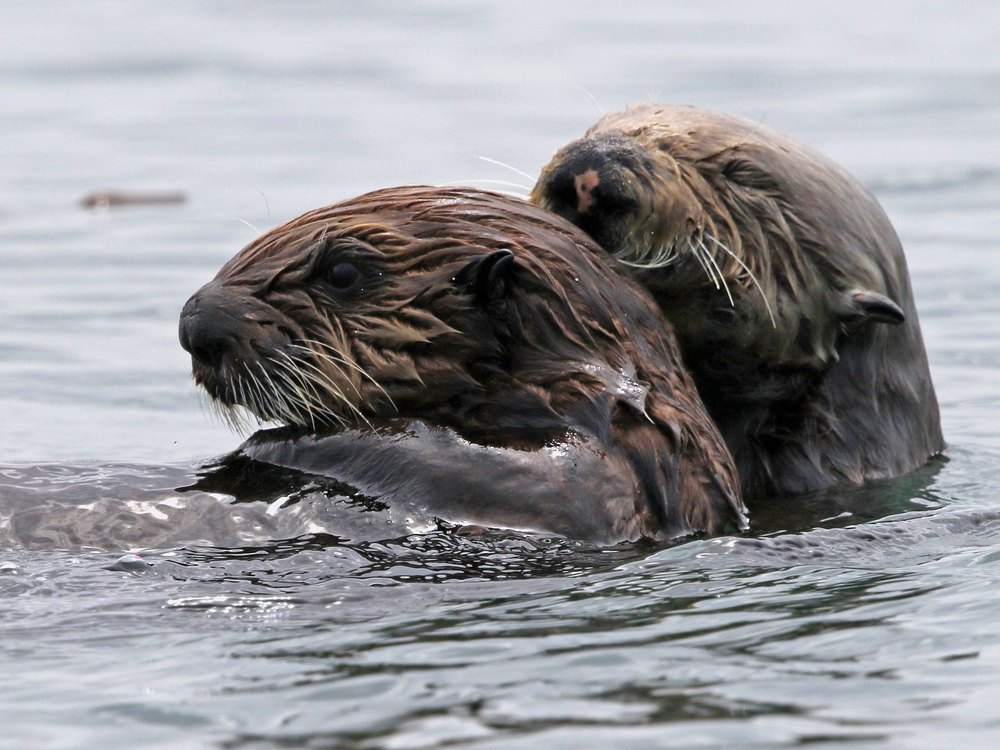
Females become sexually mature at 3 to 5 years, and males breed at about 5 to 6 years.[2] At Kodiak Island, 21% of females had pupped by age 2, 57% by age 3, 88% by age 4 and all by age 5.[30]


Lifespan
Wild females live 15–20 years and males 10–15 years.[2] In California, the oldest of 761 animals of known age was 17 years old, and the longest lives were about 13–15 years for males and 15–17 years for females.[14]
Ecology
Keeping kelp forests
In 1974, a comparison of Aleutian islands with and without Sea Otters showed that the otters help set the makeup of the shore community. They control the plant-eating animals, and where otters are removed, grazing increases and kelp beds are destroyed.[4] In an estuary in California, otters also helped eelgrass to spread.[33] The effect is not the same everywhere. After the Exxon Valdez oil spill reduced otters in one part of Prince William Sound by at least half, kelp abundance did not change.[34]
One 2012 modelling study estimated that, by keeping urchins down, otters may allow kelp forests to hold several million tonnes more carbon in living kelp across their North American range. The authors note that the long-term fate of this carbon is uncertain.[35] A modelling study of the eastern North Pacific found that where otters are present, the benefits to finfish, carbon storage and tourism could exceed the yearly loss to shellfish fisheries, if those benefits are realized. The gains and costs fall on different people.[36]

Predators
In western Alaska, otter numbers fell steeply, and the likely cause was killer whale predation. Urchins then increased and kelp declined.[37] A later study found that otters in southwest Alaska were at about 5% of the numbers the environment could carry, a pattern fitting predation better than starvation, disease or pollution.[38] Off the Commander Islands, sightings of mammal-eating killer whales showed no clear trend, which does not support that explanation there.[39] In California, white shark bites were the most common main cause of death among 560 otters examined between 1998 and 2012.[40] The sharks usually do not eat the otter. Between 1997 and 2017, the season when sharks bite otters grew from 2 to 8 months of the year.[41]
Disease and poisons
Among those 560 California otters, infectious disease was a main or contributing cause of death in 63%. Heart muscle disease was involved in 41% and domoic acid poisoning, from algae, in about 20%. The main fatal parasites were thorny-headed worms and the protozoa Sarcocystis neurona and Toxoplasma gondii. Among adult females in late pup care, so-called end-lactation syndrome was a main or contributing cause in 83%.[40] Toxoplasma infection was more common where more people lived, which suggests a role for cats as the host.[42] A liver toxin from algae in river water killed 21 southern Sea Otters.[43]
Habitat and range
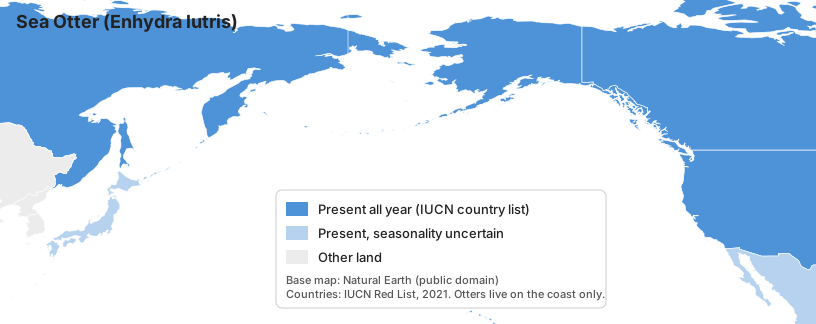
The IUCN lists the Sea Otter as native and living all year in Canada, Russia and the United States, and as native in Japan and Mexico, where the season of occurrence is uncertain.[1] Before the fur trade it lived in an arc around the North Pacific from Hokkaido, Japan, through the Kuril Islands, Kamchatka, the Commander Islands and the Aleutian Islands, along Alaska, and south to Baja California in Mexico.[1]
Habitat
Sea Otters live in the shallow sea near the coast.[44] In British Columbia they use exposed, shallow coasts with rocky reefs and soft sea floor, and kelp beds are important for resting and feeding.[45] In Prince William Sound they use both rocky and soft sea floors.[46] In California, the number of otters a stretch of coast can hold depends on the depth and distance from shore, rock or sediment, kelp cover, plant growth, and whether it is an estuary.[47] Most foraging is at depths of 40 m or less.[45] Winter sea ice limits their range in northern Kamchatka.[44]
Range today
| Place | Where Sea Otters live today |
|---|---|
| Russia | The Kamchatka Peninsula, the Kuril Islands and the Commander Islands.[44] |
| Japan | Eastern Hokkaido, where otters thought to come from the southern Kurils have been seen. Sightings were sporadic after the first confirmed live animal in 1973, and a mother and pup were seen in 2014. The group has grown slowly.[44][48] |
| Alaska | A fairly continuous range from the Aleutian Islands to Prince William Sound, plus groups in Southeast Alaska that began from moved animals.[1][44] |
| British Columbia | The west and north-east coasts of Vancouver Island and the central coast, with an extent of occurrence of 36,980 km², about a third to a half of the historical range.[45] |
| Washington | A population that began from moved animals.[1] |
| Oregon | Moved animals did not settle.[1] |
| California | The central coast from Monterey Bay to Point Conception, about 13% of the historical range, which stretched from Oregon to Baja California.[49] A group on San Nicolas Island also began from moved animals.[49] |
| Mexico | One of the 13 remnant colonies of 1911 was at the San Benito Islands. The IUCN lists the species there as of uncertain seasonality.[1] |
Evolution
The Sea Otter is one of 13 living kinds of otter.[50] The giant otter of South America is the most distant living otter, and all the others branch from after it.[51][52] The Sea Otter sits among the otters of Africa and Eurasia, but its closest relative among them is not settled. Three published trees disagree: one pairs it with the spotted-necked otter, one makes it the first branch of the Old World otters, and one makes it the first branch of a group that includes the New World river otters.[51][53][54][52]
The dates are uncertain too. A study of 22 genes put the split of the Old World otters and the Sea Otter at 4.9 million years ago (range 3.7–6.1).[51] Genome studies and compilations of published dates give about 10 million years: 10.1 million (range 6.6–15.4) for the split from the giant otter, and 10.3 million (range 7.9–12.7) from several Old World otters.[21][55] The Sea Otter lineage is therefore about 5 to 10 million years old, depending on the study. The move into the sea was recent.[21]
The oldest fossils of the genus Enhydra are about 3.6 million years old, from the Norwich Crag of England. Two extinct species are known: E. reevei from England and E. macrodonta from the Pleistocene of California.[56] The Miocene fossil otter Enhydritherium has a similar crushing dentition, but a 2017 study found no close relationship with Enhydra.[57]
Adaptations to the sea
Compared with other otters, the Sea Otter has lost many olfactory receptor genes, but the freshwater giant otter has lost them too.[21]
Population history
Today’s Californian Sea Otters are the last survivors of a divergent lineage. It was isolated from the Alaskan lineage about 4,000 generations ago, roughly 28,000 years, perhaps during the last ice age.[58] Before the fur trade, sea otters had about twice the genetic diversity of those today.[59]
Forms and variants
Subspecies
Three subspecies are recognised by the Mammal Diversity Database, ITIS, GBIF, Animal Diversity Web, COSEWIC and the IUCN.[10][12][11][7][6][1] The IUCN says they were first described by Wilson and colleagues in 1991 and confirmed by Cronin and colleagues in 1996.[1] A genetic study found that sea otters group into five broad regions (the Kuril Islands, the Commander Islands, the western Aleutians, south-central Alaska and California), and that California is a deeply divergent lineage. It did not propose changing the subspecies.[58]
| Subspecies | Common name | Range |
|---|---|---|
| Enhydra lutris lutris (Linnaeus, 1758) | Asian Sea Otter | The Kuril Islands, the Kamchatka Peninsula and the Commander Islands; the IUCN also includes Japan[1][10] |
| Enhydra lutris kenyoni Wilson, 1991 | Northern Sea Otter | From the western Aleutian Islands to Prince William Sound, along the Pacific coast of Canada, and into Oregon[1][10] |
| Enhydra lutris nereis (Merriam, 1904) | Southern Sea Otter | Central to southern California[1][10] |
Conservation
The Sea Otter is Endangered on the IUCN Red List, under criteria A2abe. It was assessed on 21 January 2020 and the result was published in 2021.[1] In Canada, COSEWIC confirmed the status of Special Concern in May 2022, and estimated about 4,000 mature individuals.[45] The southern Sea Otter has been listed as Threatened in the United States since 1977.[60][49]
Numbers
The IUCN estimates that 150,000 to 300,000 Sea Otters lived in the North Pacific before the fur trade.[1] By 1911, fewer than 2,000 are thought to have remained in 13 small colonies.[1] There is no sound count for the whole species today: counts from different years and methods should not be added together.[44] Some regional figures are in the table.
| Region | Figure | Year and method |
|---|---|---|
| Alaska, all stocks | About 73,329 | Estimates from 2000–2005, aerial surveys with correction factors[44] |
| Southeast Alaska | 22,359 | Summer 2022 aerial survey[61] |
| British Columbia | 8,110 | 2017 count and estimate, including 414 interpolated animals[45] |
| Washington | 790 | Highest count, 2006[44] |
| Russia | About 22,500 | 2007[44] |
| California mainland | 2,962 | Three-year running average for 2019[49] |
The British Columbia population grew by about 20.1% a year from 1977 to 1995 and about 8.7% a year after 1995.[45] In California the index passed the target of 3,090 in 2016, at 3,272, but fell to 2,962 in 2019. The recovery target is a three-year average above 3,090.[49] A 2024 census of the southern Sea Otter was completed, but no result had been published when this page was written.[62] Numbers in southwest Alaska fell by well over half after the mid-1980s.[38]
Threats
Oil spills are a particular danger because oil mats the fur and destroys its insulation.[16] Oil is rated as the main threat in British Columbia, and fishing-gear entanglement, illegal killing, boat strikes and climate change as lesser ones.[45] Other threats are predation by killer whales and sharks, disease, poisons from the land and sea, and poaching for fur in the Kuril Islands.[38][40][63] Low genetic diversity is a further worry.[21]
The Exxon Valdez spill of 24 March 1989 released an estimated 42 million litres of crude oil into Prince William Sound. The Sea Otter was one of more than 20 shore species considered injured.[46] Of 357 otters taken for rehabilitation, 123 died in captivity.[64] Estimates of how many otters died vary widely. In 2014 a USGS report found that the otters in the western sound met the recovery criteria used by the spill trustees, while another study argued that the evidence of recovery is not well supported.[65][66]
Protection
The United States has protected the southern Sea Otter since 1972 under the Marine Mammal Protection Act, and listed it under the Endangered Species Act in 1977.[60] The Southwest Alaska population of the northern Sea Otter was listed as Threatened in 2005, and Washington lists the species as endangered.[44] The Act does not apply to Alaska Natives who hunt for subsistence or to make and sell handicrafts, if the take is not wasteful.[67] In Southeast Alaska the reported subsistence harvest averaged 851 otters a year in 2017–2021, and is a minimum figure.[61] Surveys of the southern Sea Otter have been held every year since 1982, and are moving to a method that corrects for animals not seen.[62][44]
History and culture
The fur trade
Russian explorers reached Alaska in 1741, and about 150 years of commercial hunting followed. Hunters took otters for their pelts, which were among the most valuable furs.[1] The trade began in 1742, when the men of Bering’s expedition brought pelts back from Bering Island.[68][69] Most Russian furs went to the Chinese border market at Kyakhta, where they were traded for tea and other goods.[69] The Russian-American Company shipped more than 16,000 sea otter skins in one cargo in 1803.[69] In Canada, about 55,000 pelts were landed in British Columbia between 1785 and 1809, and by 1850 sea otters were commercially extinct there.[70] By 1911 the Sea Otter had been wiped out over most of its range.[1]
Indigenous peoples
Indigenous peoples hunted Sea Otters for thousands of years. Their harvests sometimes caused local declines, but the species stayed abundant until the mid-1700s.[1] Aleut (Unangax) hunters supplied skins to the Russian traders. The Unangax organisation APICDA says that about 12,000–15,000 Unangax lived on the Aleutian Islands around 1750, and that by 1800 their number had fallen by some 80 percent.[71] In Japan, Sea Otter fur was traded from Ainu land in the Middle Ages: the first known mention is from 1423, and Japanese traders sent it to Ming China in 1433. The Japanese word rakko probably comes from Ainu.[13]
The 1911 treaty
On 7 July 1911, the United States, Great Britain (for itself and Canada), Japan and Russia signed a convention to protect fur seals and sea otters. Article V barred citizens from killing or pursuing sea otters more than three miles from shore.[72] Because the treaty did not cover nearshore waters, it did little for southern Sea Otters, which lived there. California made the species fully protected in 1913.[68]
Recovery and moved populations
The southern Sea Otter survived as a small colony on the central California coast.[1][68] Elsewhere, people moved animals from healthy groups to empty coasts. The table lists the main programmes. Many of the moved animals died, and the first releases in Washington and British Columbia lost animals early.[73][70] Seven programmes in all produced five lasting groups, while those in Oregon and the Pribilof Islands failed.[74]
| Place | Years | Animals | Outcome |
|---|---|---|---|
| Southeast Alaska | 1965–1969 | 412 otters to six sites | Grew; about 22,359 otters in 2022[61] |
| Washington | 1969–1970 | 59 from Alaska | Grew; 790 in the highest count, 2006[73][44] |
| Oregon | 1970–1971 | About 93–95 | Failed[73][1] |
| British Columbia | 1969–1972 | 89 from Alaska to Checleset Bay | Grew to 8,110 by 2017[70][45] |
| San Nicolas Island, California | 1987 | 139 | Considered a failure at first; about 146 otters in 2023[74][49] |
Rescuing pups
The Monterey Bay Aquarium began caring for stranded southern Sea Otter pups in 1984. In 2001 it began pairing them with adult female otters as surrogate mothers. By 2018, 56 otters had been cared for and 42 released, a success rate of 75%, judged by whether they foraged, kept their weight and avoided people. The main release site, Elkhorn Slough, went from about 20 passing males to a breeding group of more than 150.[75]
Science
The northern Sea Otter genome was sequenced from a male named Elfin, rescued as a pup near Juneau, Alaska, in 2002 and later kept at the Vancouver Aquarium.[20] In 2024 researchers showed that tool use in southern Sea Otters gives better access to hard-shelled prey and protects the teeth.[18]
Taxonomy
| Rank | Name |
|---|---|
| Kingdom | Animalia |
| Phylum | Chordata |
| Class | Mammalia |
| Order | Carnivora[12][10] |
| Family | Mustelidae (the weasel family)[12][10] |
| Subfamily | Lutrinae (otters)[12][10] |
| Genus | Enhydra Fleming, 1822[11][12] |
| Species | Enhydra lutris (Linnaeus, 1758)[10][11][12] |
The Sea Otter is the only living species of Enhydra.[10][11][12] The brackets around Linnaeus mean that the species was first described in another genus: Mustela lutris. The Mammal Diversity Database gives the type locality as Kamchatka, Russia, but Linnaeus himself wrote only “Asia and northern America”.[10][9] The databases list several older names as synonyms, among them marina, gracilis and stelleri, and the names nereis and kenyoni, which are now subspecies.[10]
Sources
- IUCN Red List, Enhydra lutris (assessed 21 January 2020, published 2021)
- COSEWIC 2007, status report on the Sea Otter, chapter 8 (biology)
- U.S. Fish and Wildlife Service, southern sea otter species page
- Estes & Palmisano 1974, Science 185: 1058–1060 (abstract)
- Griffen et al. 2024, Conservation Physiology 12: coae067 (data needs for sea otter energy models)
- COSEWIC 2007, status report on the Sea Otter, chapter 5 (species information)
- Animal Diversity Web, Enhydra lutris (secondary)
- Wiktionary, Enhydra, lutra and lutris (secondary)
- Linnaeus 1758, Systema Naturae, 10th edition, vol. 1 (scan, Internet Archive)
- Mammal Diversity Database, version 2.5 (2026), Enhydra lutris
- GBIF backbone, Enhydra lutris (names from the Catalogue of Life)
- ITIS, Enhydra lutris (TSN 180547)
- Sekiguchi 2013, Bulletin of the Hokkaido University Museum 6: 46–57 (sea otter fur in medieval Japan; abstract)
- Nicholson et al. 2020, Ecology and Evolution 10: 8592–8609 (age and size of southern sea otters)
- International Wildlife Research, oiled sea otter rehabilitation course, chapter 6, “Structure and Function of Sea Otter Fur” (secondary)
- Riordan et al. 2023, Conservation Physiology 11: coad095 (thermal function of southern sea otter fur)
- Cortez et al. 2015, Journal of Experimental Marine Biology and Ecology (activity budgets of mothers and pups, Simpson Bay, Alaska)
- Law et al. 2024, Science 384: 798–802 (tool use and tooth health; abstract)
- Wright et al. 2021, Science 373: 223–225 (sea otter metabolism; abstract)
- Jones et al. 2017, Genes 8: 379 (genome of the northern sea otter)
- Beichman et al. 2019, Molecular Biology and Evolution 36: 2631–2655 (genomes of the sea otter and giant otter)
- Discover Magazine, Sea otters hold hands while sleeping and they even cuddle (secondary)
- Estes, Underwood & Karmann 1986, Journal of Wildlife Management 50: 626–636 (activity of sea otters in California; abstract)
- Bodkin, Monson & Esslinger 2007, Journal of Wildlife Management 71 (activity budgets from time-depth recorders; abstract)
- McShane et al. 1995, Journal of Mammalogy 76: 414–427 (vocalizations; abstract)
- Tinker, Bentall & Estes 2008, PNAS 105: 560–565 (food limitation and diet)
- Estes et al. 2003, Journal of Animal Ecology 72: 144–155 (individual variation in prey selection; abstract)
- Bodkin, Esslinger & Monson 2004, Marine Mammal Science 20: 305–321 (foraging depths; abstract)
- Riedman et al. 1994, Journal of Wildlife Management 58: 391–399 (breeding patterns in California; abstract)
- Monson & DeGange 1995, Canadian Journal of Zoology 73: 1161–1169 (reproduction at Kodiak Island; abstract)
- Benirschke, Comparative Placentation, sea otter (Enhydra lutris)
- Thometz et al. 2014, Journal of Experimental Biology 217: 2053–2061 (energy needs of young sea otters; abstract)
- Hughes et al. 2013, PNAS (sea otters and eelgrass in Elkhorn Slough; abstract)
- Dean et al. 2000, Marine Ecology Progress Series 199: 281 (abstract)
- Wilmers et al. 2012, Frontiers in Ecology and the Environment 10: 409–415 (kelp carbon storage; abstract)
- Gregr et al. 2020, Science 368: 1243 (benefits and costs of sea otters; abstract)
- Estes et al. 1998, Science 282: 473–476 (abstract)
- Study of the sea otter collapse in southwest Alaska, 2021, Ecological Monographs (abstract)
- Ismail et al. 2023, Russian Journal of Theriology 22: 1 (killer whales off the Commander Islands; abstract)
- Miller et al. 2020, Frontiers in Marine Science 7: 582 (mortality in southern sea otters, 1998–2012)
- “Non-trophic impacts from white sharks complicate population recovery for sea otters”, 2019, Ecology and Evolution (abstract)
- Burgess et al. 2018, Royal Society Open Science (Toxoplasma in sea otters; abstract)
- Miller et al. 2010, PLoS ONE (microcystin poisoning of sea otters; abstract)
- Doroff et al. 2011, IUCN Otter Specialist Group Bulletin 28A (sea otter status and distribution)
- COSEWIC 2022, assessment summary for the Sea Otter
- USGS Scientific Investigations Report 2011-5213 (sea otters after the Exxon Valdez spill; abstract)
- Tinker et al. 2021, Journal of Wildlife Management (habitat and carrying capacity in California; abstract)
- Hokkaido University doctoral thesis 2025 on sea otters in Hokkaido (abstract)
- Marine Mammal Commission, southern sea otter
- de Ferran et al. 2022, Current Biology 32: 3650–3658 (phylogenomics of the world’s otters; abstract)
- Koepfli et al. 2008, BMC Biology 6: 10 (phylogeny of the Mustelidae)
- Open Tree of Life, synthetic tree release 16.1, otters
- Law, Slater & Mehta 2018, Systematic Biology 67: 127–144 (tree read through the Open Tree of Life)
- Nyakatura & Bininda-Emonds 2012, BMC Biology 10: 12 (tree read through the Open Tree of Life)
- TimeTree, divergence times for the sea otter and other otters
- Paleobiology Database, Enhydra records
- Tseng et al. 2017, Biology Letters 13: 20170259 (the fossil otter Enhydritherium in Mexico)
- Beichman et al. 2023, Molecular Ecology 32: 281–298 (range-wide genetic study of sea otters)
- Larson et al. 2012, PLoS ONE 7: e32205 (genetic diversity before and after the fur trade; abstract)
- U.S. Fish and Wildlife Service news release, 10 January 1977 (southern sea otter listed as threatened)
- U.S. Fish and Wildlife Service 2023, Northern Sea Otter Stock Assessment Report, Southeast Alaska stock
- USGS Western Ecological Research Center, 2024 southern sea otter census and statistical model development
- Popov & Scopin 2021, Oryx 55: 529–534 (sea otters of the Kuril Islands; abstract)
- Estes 1992, IUCN Otter Specialist Group Bulletin 7: 33–35 (the Exxon Valdez spill and sea otters)
- USGS Open-File Report 2014-1030 (recovery of sea otters after the Exxon Valdez spill; abstract)
- Garshelis & Johnson 2013, Marine Pollution Bulletin 73 (abstract)
- Marine Mammal Protection Act, 16 U.S.C. 1371
- Carswell 2022, U.S. Fish and Wildlife Service, “On Second Chances: The Southern Sea Otter’s Return to Ecological Relevance”
- Oxford Global History of Capitalism, case study 23 (2022), “The Alaskan fur rush and the Russian-American Company” (secondary)
- Fisheries and Oceans Canada, recovery strategy for the Sea Otter, chapter 1
- Aleutian Pribilof Islands Community Development Association, “Aleut Culture” (secondary)
- Convention for the preservation and protection of fur seals and sea otters, Washington, 7 July 1911 (Foreign Relations of the United States 1911)
- USGS, “Sea otters in the northern Pacific Ocean” (Our Living Resources, archived 2004 copy)
- Davis et al. 2019, Frontiers in Marine Science 5: 510 (future directions in sea otter research and management)
- Becker et al. 2020, Frontiers in Marine Science 7: 539904 (surrogate-reared sea otters released at Elkhorn Slough)